How to Beat Jet Lag: What Actually Works
Quick answer: To reduce jet lag, shift your sleep 30-60 minutes a day before departure, switch to local time when you board, get daylight at the right time at your destination, keep naps to 20-30 minutes, and use caffeine only early in the local day. Melatonin may help some travelers, but ask a doctor or pharmacist first.
Imagine arriving in an exciting new destination after a long international flight. You have beautiful places to explore, restaurants to visit, and a full holiday ahead. There is just one problem: your body thinks it is the middle of the night, even though the local clock says it is lunchtime. Later, when you finally get into bed, you find yourself wide awake at 3 a.m.
This is jet lag, and it can make even the most enjoyable trip feel exhausting.
The good news is that there are practical ways to reduce its effects. While no method can instantly reset your internal body clock, understanding how jet lag works can help you adjust more comfortably and avoid losing several valuable days of your trip.
If you are wondering how to beat jet lag, the most effective approach involves three main things: managing light exposure, adjusting your sleep schedule, and following the local time at your destination. Some popular remedies can also help you feel better, while others are less effective than people often believe.
Here is what actually works, what you can probably skip, and how to create a realistic plan before, during, and after your flight.
What Is Jet Lag and Why Does It Happen?
Jet lag is a temporary sleep-related condition that occurs when you travel rapidly across multiple time zones. Your internal body clock, also known as your circadian rhythm, becomes temporarily misaligned with the local time at your destination.
Your circadian rhythm regulates several important biological processes, including sleep and wakefulness, body temperature, hormone production, and digestion. It follows an approximately 24-hour cycle and responds primarily to environmental signals, especially daylight and darkness.
When you travel across several time zones, your surroundings change much faster than your body can adapt.
For example, imagine flying from New York to Paris. When you arrive, it may be early morning locally, but your body could still be operating according to New York time. Your brain may interpret the morning as nighttime, making it difficult to stay awake.

Common jet lag symptoms include:
- Difficulty falling asleep or waking up too early.
- Daytime tiredness and reduced energy.
- Poor concentration and difficulty remembering things.
- Irritability and mood changes.
- Headaches and general discomfort.
- Digestive problems, including constipation or changes in appetite.
The severity of symptoms depends on several factors, including the number of time zones crossed, the direction of travel, individual sleep patterns, and how quickly you adapt to the new environment.
Jet lag is not simply a lack of sleep. Even travelers who manage to sleep during their flight can experience symptoms because their internal biological clock is still out of sync.
Why Is Traveling East Usually Harder Than Traveling West?
If you have ever traveled in both directions across several time zones, you may have noticed that one journey feels considerably harder than the other.
For many people, traveling east causes more noticeable jet lag than traveling west.
The reason is connected to how the human circadian rhythm naturally works.
Most people’s internal body clock runs slightly longer than 24 hours. This means the body generally finds it easier to delay its sleep schedule than to advance it.
When traveling west, you effectively gain hours. Staying awake a little longer is often easier than forcing yourself to fall asleep earlier than your body expects.
Traveling east does the opposite. You lose hours and need to move your sleep schedule forward. If you normally go to bed at midnight, for example, your destination may require you to go to bed when your body still feels that it is early evening.
According to the CDC, adaptation generally happens faster after westward travel than after eastward travel, although individual experiences vary.
This is why planning ahead is particularly useful when traveling east across several time zones.
How to Beat Jet Lag: What Actually Works
Not every jet lag remedy has the same level of scientific support. Some strategies directly influence your biological clock, while others simply make the symptoms easier to manage.
Understanding the difference helps you focus on the methods that offer the greatest benefit.
1. Use Natural Light to Reset Your Body Clock
Light exposure is one of the strongest signals that helps regulate your circadian rhythm.
Your brain uses information about daylight and darkness to determine when it should prepare for sleep and when it should promote alertness.
However, the timing of light exposure matters.
Generally:
- Morning light helps advance your body clock, encouraging an earlier sleep and wake schedule.
- Evening light helps delay your body clock, encouraging a later sleep and wake schedule.
This distinction is particularly important when traveling across multiple time zones.
For example, someone traveling east may benefit from appropriately timed morning daylight because the goal is to shift the body clock earlier. Someone traveling west may benefit from evening light to help shift the body clock later.
However, there is an important detail: the best time for light exposure depends on the direction of travel and the number of time zones crossed. Exposure at the wrong biological time can actually move your body clock in the opposite direction.
For a typical traveler, spending time outdoors during the destination’s daylight hours is a useful starting point. For journeys involving many time zones, a personalized light-exposure schedule can be more effective.
2. Adjust Your Sleep Schedule Before Departure
One of the easiest ways to reduce jet lag is to start preparing before you leave home.

Instead of waiting until you arrive to change your sleeping habits, gradually move your bedtime and wake-up time toward the destination’s schedule.
Try adjusting your routine by approximately 30–60 minutes each day for several days before departure.
For eastward travel, gradually go to bed and wake up earlier.
For westward travel, gradually go to bed and wake up later.
You do not need to make dramatic changes. Even modest adjustments can help reduce the difference between your usual routine and the destination’s time zone.
You can also gradually adjust meal times to match the new schedule.
The CDC recommends shifting sleep toward the destination’s time zone during the two or three days before departure when practical.
3. Start Following Local Time Immediately
Once you board your flight, change your watch or phone clock to the destination’s local time.
This simple step can help you mentally prepare for the new schedule.
Try to organize your sleep, meals, and activities around the destination’s time rather than constantly thinking about what time it is back home.
For example, if it is nighttime at your destination, try to sleep during the flight if circumstances allow. If it is daytime, remain reasonably active and avoid sleeping for several unnecessary hours.
You will not always be able to follow the ideal schedule, especially during long flights, but making the transition gradually can help.
Flight timing also matters. When choosing your departure and arrival times, consider whether you will have an opportunity to rest before your first important activity.
For additional planning advice, see our guide to Flight Booking Hacks That Save Money, which explores ways to make smarter decisions when booking flights.
4. Take Short Naps Instead of Sleeping for Hours
Arriving at your destination after a long flight can leave you feeling exhausted. A short nap may help restore some energy, particularly if you have had very little sleep during the journey.
However, there is a difference between a helpful nap and spending most of the afternoon asleep.
A nap lasting approximately 20–30 minutes can improve alertness without significantly interfering with nighttime sleep.
Longer naps, especially late in the afternoon or evening, may make it harder to fall asleep at the appropriate local bedtime.
If you arrive in the morning or early afternoon, try to remain awake until a reasonable local bedtime. If you are struggling to stay alert, take a brief nap rather than sleeping for several hours.
The objective is to build enough sleep pressure to make nighttime sleep easier.
5. Consider Melatonin Carefully
Melatonin is a hormone naturally produced by the brain in response to darkness. It plays an important role in regulating the sleep-wake cycle.
Melatonin supplements are sometimes used to help travelers adjust to new time zones, particularly after eastward journeys.
There is scientific evidence suggesting that appropriately timed melatonin can help reduce jet lag symptoms. However, timing is important.
Taking it at the wrong time can interfere with the body’s adjustment rather than help it.
Melatonin is also not suitable for everyone. Its availability, regulation, and product quality vary between countries.

Before using melatonin, speak with a doctor or pharmacist, particularly if you:
- Take prescription medications or other supplements.
- Have an existing medical condition.
- Are pregnant or breastfeeding.
- Have a history of sleep-related problems.
Do not assume that taking a larger dose will produce better results. More is not necessarily more effective.
Melatonin should be considered an optional aid rather than a replacement for proper sleep scheduling and light exposure.
6. Use Caffeine Strategically
Coffee and other caffeinated drinks can help you remain alert when your body is struggling to adjust to the local schedule.
However, drinking coffee throughout the day can make nighttime sleep more difficult.
The best approach is to use caffeine selectively, particularly during the earlier part of the destination’s daytime.
For example, a morning coffee may help you stay alert after an uncomfortable night. However, drinking several coffees late in the afternoon could make it harder to fall asleep that evening.
As a general rule, avoid caffeine for approximately six hours before your intended bedtime, or longer if you are particularly sensitive to it.
Remember that caffeine does not correct your internal body clock. It simply helps manage sleepiness temporarily.
Popular Jet Lag Remedies That Are Overrated
Some common recommendations sound convincing but do not directly address the biological changes responsible for jet lag.
That does not mean every suggestion is completely useless. It simply means travelers should understand what each approach can and cannot accomplish.
Drinking Excessive Amounts of Water
Staying hydrated during air travel is sensible. Cabin conditions can contribute to discomfort, and dehydration may make headaches and fatigue feel worse.
However, drinking excessive amounts of water will not reset your circadian rhythm.
Drink regularly according to your thirst and avoid becoming dehydrated, but do not expect hydration alone to eliminate jet lag.
Drinking Alcohol to Fall Asleep
Alcohol may make you feel sleepy initially, which is why some travelers use it to relax during long flights.
Unfortunately, it can also fragment sleep and reduce sleep quality.
You may fall asleep more quickly but wake up repeatedly or feel less rested afterward.
If your goal is to arrive feeling refreshed, limiting alcohol during the flight is a better strategy.
Following Strict Jet Lag Diets
You may come across special eating schedules that promise to prevent jet lag through fasting, alternating meal patterns, or unusual combinations of foods.
Although meal timing can influence biological rhythms, evidence supporting complicated jet lag diets is limited.
There is no need to follow a strict or uncomfortable eating plan.
Instead, eat balanced meals at approximately the local times and avoid unnecessarily heavy meals immediately before bedtime.
Sleeping Through the Entire First Day
After a long flight, spending the first day sleeping may seem like the most comfortable option.
However, sleeping for several hours during the destination’s daytime can make nighttime sleep more difficult.

Unless you are dealing with significant sleep deprivation or another health concern, try to maintain a reasonable daytime routine and reserve your main sleep period for the local night.
A Simple Jet Lag Plan: Before, During, and After Your Flight
The most effective approach is to combine several small adjustments rather than rely on one miracle remedy.
Here is a practical schedule that occasional travelers can follow.
Three Days Before Departure
Start preparing your body for the destination’s time zone.
- Gradually move your bedtime and wake-up time toward the destination schedule.
- Adjust meal times slightly if practical.
- Avoid sacrificing sleep to make the adjustment faster.
- Check your arrival time and plan your first day accordingly.
- Consider using a travel-planning tool to organize your itinerary.
Our article on 12 Best Apps for Travel Planning can help you find useful tools for organizing flights, accommodation, and daily activities.
During the Flight
Your objective is to arrive as rested as reasonably possible.
- Set your watch to the destination’s local time.
- Sleep when it corresponds reasonably with nighttime at your destination.
- Avoid excessive caffeine and alcohol.
- Drink water regularly.
- Move around and stretch when it is safe to do so.
- Use an eye mask and earplugs if they help you sleep.
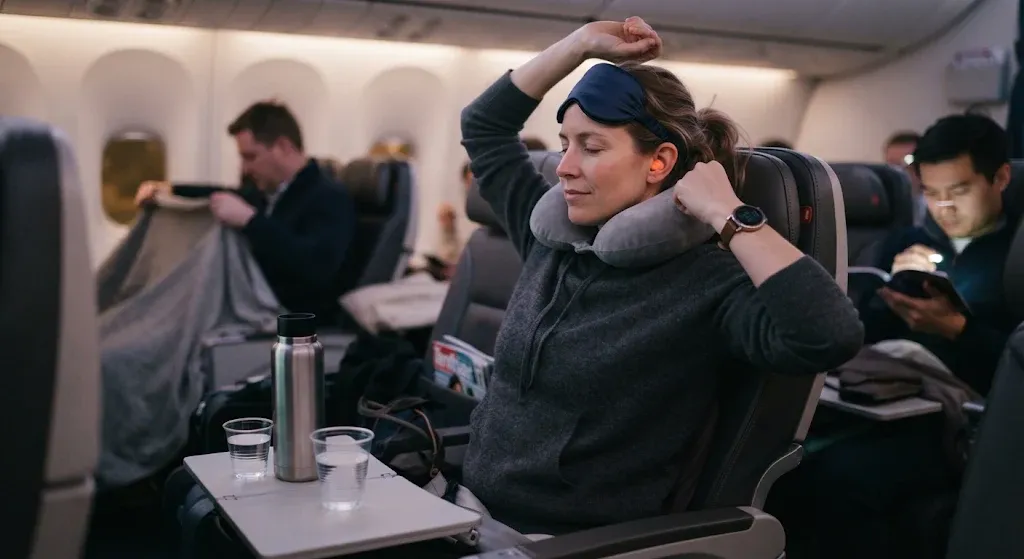
Do not worry if you cannot follow the schedule perfectly. The goal is to reduce disruption, not create additional stress.
Your First Day at the Destination
This is an important day for establishing your new routine.
Try to:
- Spend time outdoors during appropriately timed daylight.
- Eat meals according to local time.
- Avoid long daytime naps.
- Take a gentle walk if you feel comfortable.
- Keep your evening relatively relaxed.
- Go to bed at a reasonable local bedtime.
If you are planning a solo trip, avoid filling your first day with too many activities. A manageable itinerary gives you more flexibility to rest and adjust.
Our guide on How to Plan Solo Travel Without Feeling Overwhelmed offers additional suggestions for creating a comfortable and organized travel experience.
Days Two and Three
Consistency becomes particularly important during the next few days.
Continue waking up at approximately the same local time, eating regular meals, and getting appropriate daylight exposure.
Avoid compensating for a poor night’s sleep by spending the following day in bed.
If you feel tired, take a short nap when necessary, but try to preserve your regular nighttime sleep schedule.
For many travelers, symptoms begin improving over several days as the body gradually adjusts.
Should You Adjust Your Body Clock for a Very Short Trip?
Here is a practical tip that many travelers overlook: you may not need to adjust your body clock at all if your trip is extremely short.
For journeys lasting only one or two days, following your usual home schedule can sometimes be easier than adapting to a new time zone and then readjusting immediately after returning.
For example, someone traveling internationally for a short business meeting may benefit from maintaining their usual sleeping and eating schedule as much as practical.
The decision depends on the time difference, the purpose of the trip, and the activities planned.
If you are visiting for a longer holiday, adjusting to local time generally makes more sense.
The NHS also suggests that travelers on short trips of two to three days may consider maintaining their usual home schedule.
When Is Jet Lag More Than Just Tiredness?
Jet lag is usually temporary, and most people gradually recover without medical treatment.
However, persistent or unusually severe sleep problems should not automatically be attributed to travel.
If symptoms continue without improvement, significantly interfere with daily activities, or are accompanied by concerning health symptoms, consult a healthcare professional.
Travelers with existing sleep disorders or medical conditions may also benefit from discussing their travel plans with a doctor before departure.
It is worth remembering that travel insurance can provide additional protection when unexpected health problems arise abroad. Our guide to Travel Insurance Basics That Protect Your Trip explains some of the important considerations before leaving home.
Melatonin for Jet Lag: Does It Really Help?
Melatonin is one of the most commonly discussed options for travelers looking for relief from jet lag. This hormone helps regulate the body’s sleep-wake cycle by signaling that it is time to prepare for sleep.
Research suggests that melatonin supplements can help reduce jet lag symptoms, particularly after traveling across several time zones eastward. However, timing is more important than simply taking it at bedtime.
Taking melatonin at the wrong time may interfere with your body’s adjustment to the new time zone. It can also cause side effects such as daytime sleepiness, dizziness, or headaches.
Before using melatonin, consult a doctor or pharmacist, especially if you take other medications, have an existing health condition, or are pregnant or breastfeeding.
Melatonin may be a useful addition to your travel routine, but it is not a substitute for properly timed light exposure and a consistent sleep schedule.
Jet Lag Remedies: Which Ones Are Worth Trying?
When searching for effective jet lag remedies, it is easy to become overwhelmed by supplements, special diets, sleep products, and travel advice.
You do not need an elaborate routine to make your trip more comfortable. Some of the most useful strategies are also the simplest: get natural daylight at the appropriate time, drink enough water, eat meals according to local time, and maintain a consistent sleep schedule.
A comfortable eye mask and earplugs can make sleeping during a long flight easier, while short daytime naps may help manage fatigue without disrupting nighttime sleep. Caffeine can also improve alertness when used early in the local day, but avoid relying on it late in the afternoon.
Be cautious of products promising to eliminate jet lag overnight. The most reliable approach is to combine practical travel habits with strategies that help your internal body clock gradually adjust.
Can You Fix Jet Lag Fast?
There is no instant way to fix jet lag. Your internal body clock needs time to adjust to a new time zone, and no drink, supplement, or sleep trick can reset it overnight. However, you can speed up the adjustment by following a few evidence-based strategies.
Get appropriately timed natural light (morning light when traveling east and late-afternoon or evening light when traveling west), follow the local sleep and meal schedule, avoid long daytime naps, and limit caffeine late in the day.
Gradually shifting your bedtime before departure can also help. Melatonin may offer additional support for some travelers when correctly timed, but it is not suitable for everyone.
The key is to combine these strategies consistently rather than rely on a single quick remedy. Although recovery time varies, these steps can help reduce symptoms and make the first few days at your destination more manageable.
Final Thoughts: How to Beat Jet Lag Without Losing Your Holiday
Learning how to beat jet lag is less about finding a quick remedy and more about helping your body adjust naturally to a different time zone.
Three things make the biggest difference when managing jet lag: getting appropriately timed light exposure (morning light when traveling east, and late-afternoon or evening light when traveling west), gradually adjusting your sleep schedule before departure, and maintaining a consistent routine once you arrive.
For journeys crossing eight or more time zones, light exposure becomes more complicated because the timing can shift your body clock in the wrong direction. The CDC advises taking extra care with light exposure and sleep timing on these longer eastward or westward journeys.
Preparing a few days before departure, avoiding excessive alcohol, using short naps strategically, and following local mealtimes can also make the transition easier.
Rememeber to give yourself time.
Your body cannot always adapt as quickly as your travel itinerary demands. Instead of expecting to feel completely refreshed immediately after landing, plan your first few days with enough flexibility to rest and recover.
A little preparation can make a meaningful difference between spending your holiday fighting exhaustion and having the energy to enjoy the destination you traveled so far to experience.
Frequently Asked Questions About Jet Lag
A common rule of thumb is about one day of recovery per time zone crossed, often faster when traveling west. Larger time differences generally require more adjustment.
Some older adults experience changes in sleep patterns and circadian rhythms that can make travel-related sleep disruption more noticeable. However, age alone does not determine how severe jet lag will be. Individual health, sleep habits, travel direction, and the number of time zones crossed also matter.
Ordinary short flights within the same time zone do not usually cause jet lag because the destination’s local time remains similar to your body’s internal schedule. However, flights crossing multiple time zones can cause jet lag even when the actual flight duration is relatively short.
There is no universally ideal arrival time. Daytime arrivals can provide an opportunity to experience natural light and begin following the local schedule, while evening arrivals may allow you to go directly to bed. The best option depends on the direction of travel, the time difference, and your planned activities after landing.
Sources used for medical fact-checking
- CDC, Yellow Book 2026 – Jet Lag Disorder: https://www.cdc.gov/yellow-book/hcp/travel-air-sea/jet-lag-disorder.html
- NHS, Jet Lag: https://www.nhs.uk/conditions/jet-lag/
- NHS, Melatonin: https://www.nhs.uk/medicines/melatonin/
How we fact-checked this article: The article distinguishes between measures that help reset the circadian rhythm and measures that merely reduce discomfort. This is important for credibility, particularly in the sections on hydration, caffeine and melatonin.
General information, not medical advice.
Related posts:
 How to Stop Overthinking and Feel Calmer
 TikTok-Famous Food Trends: Viral Recipes and Kitchen Hacks That Took Over 2025
 Making Mistakes Safely: The Smarter Way to Learn Trading with Quotex
 Is the Traditional Classroom Model Still Relevant in the Age of Hybrid Learning?
 Smart Borrowing: Tips for Choosing an Auto Loan You Can Afford