Where Do Common Phrases Come From? The Stories Behind “Break the Ice,” “Bite the Bullet,” and “Saved by the Bell”
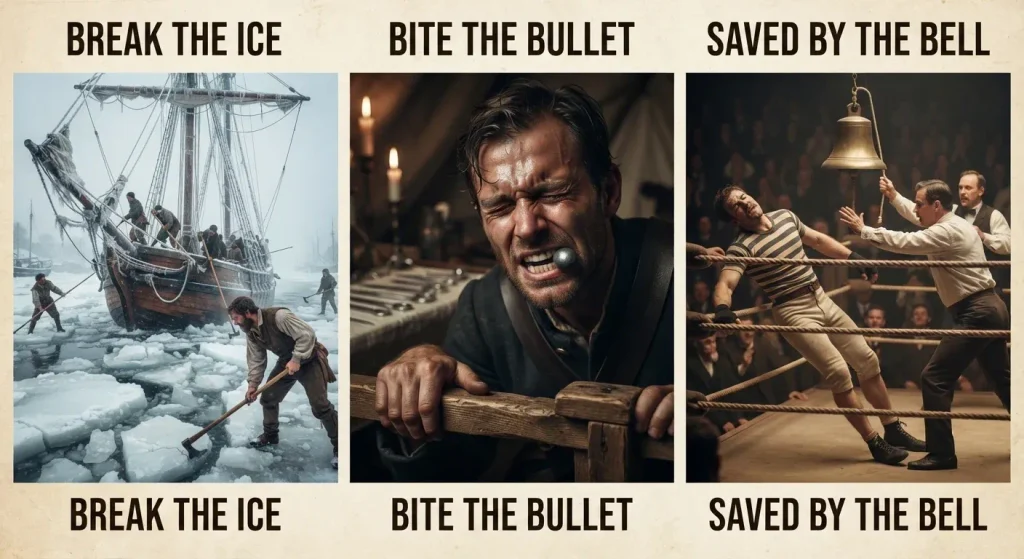
We use idioms every day without thinking about them. We break the ice at parties, bite the bullet at the dentist, and feel saved by the bell when a meeting ends just in time. But where do these phrases actually come from?
The answers are more interesting than you might expect. Some of the best-known explanations turn out to be doubtful, while the real histories are often stranger and more human. Here is a look at three popular phrases, what we know, and what is just a good story.
What Is an Idiom, Exactly?
An idiom is a phrase whose meaning cannot be worked out from its individual words. Nobody is literally breaking anything when they start a conversation, and no one is chewing on ammunition when they accept something unpleasant. Idioms survive because they are vivid, short, and shared. Over time, the original image fades, and the meaning is all that is left.
“Break the Ice”
Meaning: To ease tension and start a conversation, especially among people who do not know each other.
The popular story: In the past, ships stuck in frozen harbors or rivers needed a path cleared before they could travel and trade. Smaller boats would crush the ice to open the way, so “breaking the ice” became a symbol for making a first move that lets everything else follow.
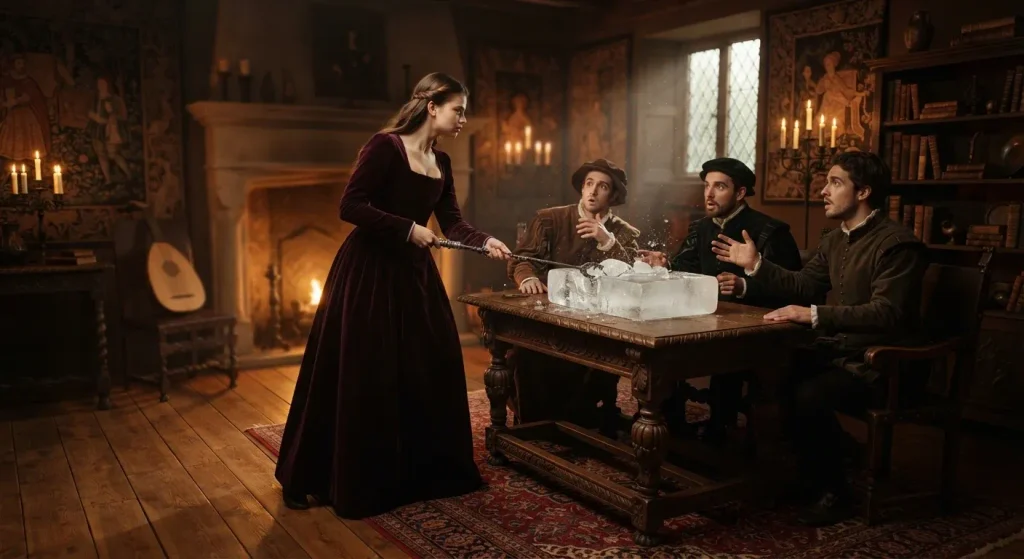
What we actually know: The figurative use appears in English in the 1500s, and it shows up in Shakespeare’s The Taming of the Shrew, where a character offers to “break the ice” in a matchmaking scheme. The ship explanation is appealing and frequently repeated, but there is little firm evidence that it came first. A simpler explanation may be just as likely: ice is a natural barrier, and breaking it is the obvious first step in getting through. The metaphor works whether or not any ships were involved.
Fun fact: Today, the phrase has given its name to “icebreaker” games, the little activities used in classrooms and workshops to get people talking.
“Bite the Bullet”
Meaning: To face something painful or unpleasant with courage and get on with it.
The popular story: Before modern anesthesia, wounded soldiers supposedly clenched a bullet between their teeth to cope with the pain of surgery or amputation on the battlefield. The act of biting down became shorthand for enduring something hard.
What we actually know: The story is plausible, because doctors really did operate on conscious patients in harsh conditions, and patients were sometimes given something to bite on. However, there is no solid evidence that this is how the phrase began. One of the earliest known printed uses comes from Rudyard Kipling’s 1891 novel The Light That Failed, where a character is told to bite on the bullet and not let others see he is afraid. After that, the expression spread quickly in both Britain and the United States.
Why it stuck: The image is physical and instantly understandable. Even if the battlefield origin is only partly true, it matches how the phrase feels: clenched teeth, held breath, and no way around the pain.
“Saved by the Bell”
Meaning: Rescued from a difficult situation at the very last moment.
The popular story: In the 1700s and 1800s, people feared being buried alive. Some coffins were supposedly fitted with a string connected to a bell above ground, so that anyone who woke up in the grave could ring for help. According to the legend, this is where “saved by the bell,” “graveyard shift,” and “dead ringer” come from.
What we actually know: Safety coffins and fears of premature burial were real, and a few inventors did patent such designs. But there is no good evidence that the phrases came from them. The more likely source is boxing. In a boxing match, the bell ends a round, and a fighter who was about to be knocked out could be rescued when the bell rang before the referee finished counting. By the late 1800s, the phrase was being used for any narrow escape.
Pop culture bonus: Later, school bells gave the phrase a second life. Students “saved by the bell” could escape a difficult question when class ended, which is partly why the 1989 TV series took that name.

Why Do Some Phrase Origins Turn Out to Be Wrong?
Many “origin stories” spread because they are entertaining and easy to repeat, not because they are well documented. A few reasons explain why:
- Language is mostly spoken. Everyday phrases were used for years before anyone wrote them down, so early history is often missing.
- Good stories travel faster than facts. A dramatic explanation about coffins or battlefields is easier to remember than “first recorded in 1891.”
- Hindsight invents logic. Once we know a meaning, it is tempting to find a neat explanation that fits it.
When researching phrase origins, look for the earliest dated written use. That is far more reliable than a story that simply sounds right.
More Phrases With Surprising Backgrounds
- “Spill the beans”: Often linked to ancient Greek voting with beans, but the evidence is thin, and the phrase seems to be much more recent.
- “Rule of thumb”: Often said to come from a law allowing a man to beat his wife with a stick no thicker than his thumb. There is no evidence for that law, and the phrase more likely refers to using a thumb as a rough measuring tool.
- “Let the cat out of the bag”: Sometimes explained by market cons involving cats sold in place of piglets, though this is also debated.
The pattern repeats: the most colorful explanation is not always the correct one.
Frequently Asked Questions
The figurative meaning dates to the 1500s and appears in Shakespeare. The idea of ships breaking through ice is a common explanation, but it is not firmly proven.
Possibly, in some situations, but there is no clear proof that this is where the idiom came from. One of the earliest printed examples is from Kipling in 1891.
Unlikely. Most language experts connect it to boxing, where the bell ends a round and can save a fighter from being knocked out.
Use reputable sources such as the Oxford English Dictionary, the Merriam-Webster dictionary, or etymology databases, and look for the earliest recorded use.
Final Thoughts
The next time you break the ice, bite the bullet, or get saved by the bell, you will know that each phrase carries a small piece of history, and that some of the most popular explanations deserve a second look. Language is full of fascinating mysteries, and sometimes the truth is that nobody knows for sure.
What is your favorite phrase, and where do you think it came from? Share it in the comments.
Sources
- Oxford English Dictionary (OED) – Historical definitions and earliest recorded uses of English idioms.
- Merriam-Webster Dictionary – Definitions and explanations of English idioms and expressions.
- Phrase Finder – “Bite the Bullet: Meaning and Origin”
- Phrase Finder – “Saved by the Bell: Meaning and Origin”
- AAP FactCheck – Phrase origins linked to burials
- Kipling, Rudyard. The Light That Failed (1891).
Related posts:
 How to Stop Overthinking and Feel Calmer
 How to Build Better Saving Habits (Without Hating Your Life)
 Making Mistakes Safely: The Smarter Way to Learn Trading with Quotex
 Is the Traditional Classroom Model Still Relevant in the Age of Hybrid Learning?
 Smart Borrowing: Tips for Choosing an Auto Loan You Can Afford