10 Benefits of Entrepreneurship for Students
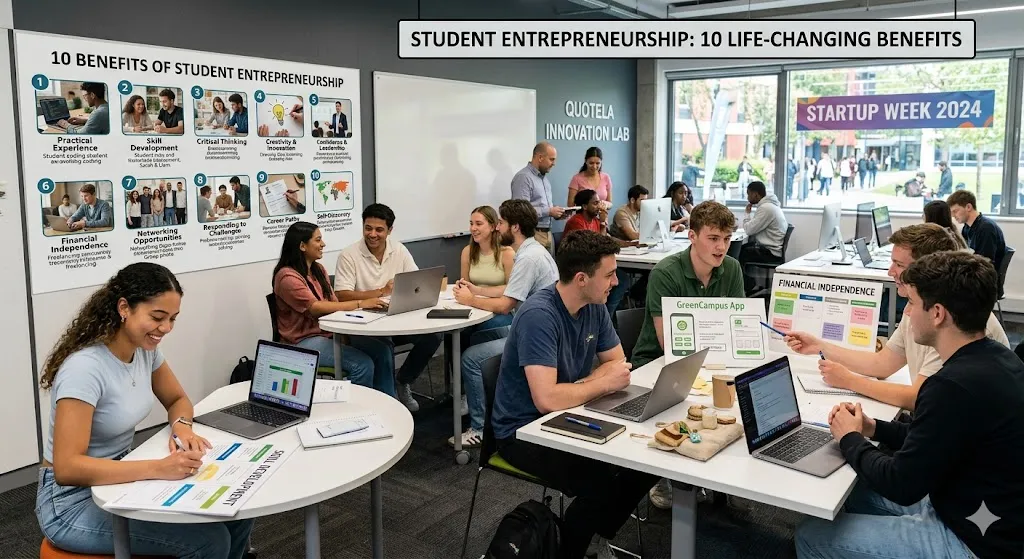
A student who sells custom phone cases from a dorm room learns something a textbook rarely teaches fast enough – how to solve a real problem for real people under real pressure. That is where many of the benefits of entrepreneurship for students become obvious. It turns ideas into action, and action into skills that stay useful long after graduation.
For students, entrepreneurship is not just about launching the next big startup. It can be as simple as tutoring online, reselling vintage clothes, building a small app, managing social media for local businesses, or starting a campus-based service. The scale can be small, but the lessons are often huge.
According to entrepreneurship education research, students exposed to entrepreneurial learning often report stronger confidence, leadership ability, and career adaptability compared to traditional classroom-only learning experiences.
Why the benefits of entrepreneurship for students matter early
Starting early gives students a practical edge. While some classmates are waiting until after graduation to figure out what kind of work suits them, student entrepreneurs get a head start on testing strengths, interests, and earning potential.
That early exposure matters because modern careers are less linear than they used to be. Employers value initiative, adaptability, and problem-solving. So do clients, collaborators, and investors. Entrepreneurship helps students practice all three in a way that feels more real than classroom theory alone.
There is also a mindset shift involved. When students build something of their own, they stop seeing the world only as consumers of products, courses, or jobs. They start noticing gaps, opportunities, and ways to create value. That perspective can shape every future career move, whether they stay in business for themselves or not.
| Benefit | Core Advantage | Real-World Impact |
|---|---|---|
| 1. Accelerated Skill-Building | Immediate feedback loop | Master marketing, finance, and operations simultaneously. |
| 2. Active Risk Resilience | Normalizes failure as feedback | Prepares students to navigate uncertain job markets. |
| 3. Financial Independence | Scalable income generation | Reduces dependence on low-wage, rigid hourly jobs. |
| 4. Organic Professional Networking | Grounded, value-first connections | Builds relationships with mentors, clients, and partners. |
| 5. Natural Resume Enrichment | Proof of execution and ownership | Offers hiring managers concrete metrics over theory. |
| 6. Accelerated Self-Discovery | Low-risk career testing | Helps students discover what day-to-day work they actually enjoy. |
| 7. Radical Career Flexibility | Expands professional options | Prepares students to be adaptive employees or independent creators. |
| 8. Real Decision-Driven Confidence | Confidence built on evidence | Teaches students to pitch ideas and handle rejection. |
| 9. Shift to Value-Creation Mindset | Moves from consumer to creator | Encourages students to spot gaps and opportunities in any market. |
| 10. Practical Edge Early On | Head start on career readiness | Gives students a competitive advantage before graduation. |
Entrepreneurship builds real-world skills faster
One of the biggest benefits of entrepreneurship for students is how quickly it develops practical skills. A student business forces decisions. You have to communicate clearly, manage time, budget money, promote your offer, and keep customers happy. Those are transferable skills in almost every industry.
The difference is speed. In a regular class, feedback might come after a test or final project. In entrepreneurship, feedback comes immediately. If your pricing is off, sales slow down. If your messaging is confusing, people ignore it. If your service is strong, referrals start showing up.
That kind of fast learning can make students more capable and more confident. It also helps them understand how different business functions connect. Marketing is not separate from customer service. Finance is not separate from operations. Everything affects everything else.
Confidence grows when students make decisions
Confidence built through entrepreneurship tends to be stronger than confidence built only through praise. It comes from evidence. You tried something, adjusted it, and saw a result.
That matters for students who are still figuring themselves out. Running even a small venture teaches them how to pitch an idea, handle rejection, negotiate, and recover from mistakes. Those moments can be uncomfortable, but they are often what push personal growth forward.
The trade-off is that confidence does not arrive instantly. Early efforts can feel messy, and some students may compare themselves to founders who have more money, experience, or time. Still, even small wins can change how a student sees their own potential.
It can create income and reduce dependence
Money is not the only reason to start, but it is a very real one. A student business can create extra income for books, rent, transport, or savings. For some, it can reduce reliance on part-time jobs that offer less flexibility and fewer growth opportunities.
This is one of the more practical benefits of entrepreneurship for students. Instead of trading time for fixed hourly pay alone, students can experiment with earning based on value, demand, and systems. A tutoring service, design freelance business, or digital product can sometimes scale in a way a standard campus job cannot.
That said, income is rarely instant or guaranteed. Some ventures take time before they become profitable, and some never do. Students need realistic expectations, especially if they are balancing tuition costs and academic deadlines. Entrepreneurship can support financial independence, but it also comes with risk.
Students learn resilience in a way few classes teach
A missed sale, a bad review, a failed launch, a marketing post that gets ignored – entrepreneurship gives students plenty of chances to build resilience. At first, that may not sound like a benefit. In practice, it is one of the most valuable parts.
Students who learn how to handle setbacks without giving up often become stronger professionals later. They understand that failure is not always a verdict. Sometimes it is simply feedback. That is a powerful lesson in business and in life.
This resilience is especially useful in uncertain job markets. A student who has already learned to adapt, test new ideas, and keep going under pressure may be better prepared than someone who has only followed a set path.
Networking becomes more natural and more useful
When students start a project, business, or side hustle, they usually begin meeting people outside their normal social circle. That might include customers, suppliers, mentors, freelancers, local business owners, or online communities.
These relationships can open doors that traditional student life does not always provide. A conversation with one client can lead to referrals. A campus pop-up can turn into a partnership. A small freelance project can become a full-time opportunity after graduation.
The key advantage is that the networking feels more grounded. Students are not just collecting contacts. They are connecting through real work, shared interests, and visible initiative. That often leaves a stronger impression than a polished resume alone.
Entrepreneurship can strengthen a resume without feeling forced
Employers often say they want candidates with experience, but students are usually told they need a job to get experience in the first place. Entrepreneurship helps close that gap.
A student who has built a small business can point to concrete achievements. They can talk about revenue, customer growth, marketing campaigns, product testing, or process improvements. Even if the venture stayed small, the experience can show leadership, creativity, and ownership.
This matters because many hiring managers look for evidence of action. A student entrepreneur can often show that they did not just study business, marketing, design, or tech. They applied it.
It helps students discover what they actually want
Plenty of students choose majors before they really know what day-to-day work in that field feels like. Entrepreneurship gives them a low-risk way to test interests in the real world.
Someone studying computer science may realize they love building products but dislike managing clients. A business student may discover they are better at sales than operations. A creative student may learn they enjoy content strategy more than graphic design. These discoveries are useful, even when a business idea does not last.
This is one reason entrepreneurship can be so valuable during student years. It shortens the distance between theory and self-knowledge. Instead of guessing, students get clearer signals from actual experience.
Career flexibility becomes a real option
How to be an Entrepreneur
Not every student entrepreneur wants to become a founder full time. Some will. Others will use what they learn to become better employees, freelancers, managers, or creators.
That flexibility is a major advantage. Entrepreneurship does not trap students into one path. It can expand their options. A successful side business can stay part time. A failed venture can still lead to a stronger portfolio. A freelance project can become a bridge between college and a first serious role.
For a generation that values independence and adaptability, that matters. Students are not just preparing for one job title. They are preparing for a changing economy.
The trade-offs are real, and students should be honest about them
Entrepreneurship is not automatically the right move for every student at every stage. Time pressure is the biggest issue. If a business starts hurting grades, sleep, or mental health, the cost may be too high.
There is also the risk of chasing the image of entrepreneurship instead of the substance. Social media makes business ownership look glamorous, but most student ventures involve repetition, uncertainty, and small tasks done consistently. That is less exciting, but more honest.
It also depends on personal circumstances. Some students have financial support, flexible schedules, or access to mentors. Others are already managing work, family responsibilities, or debt. Starting a business from campus can be empowering, but it is not equally easy for everyone.
That is why a small, practical start often makes the most sense. A simple service business, digital side hustle, or campus-based offer can teach the same core lessons without creating unnecessary pressure.
A smarter way to think about student entrepreneurship
The best reason to start is not fame, fast money, or the label of founder. It is growth. Entrepreneurship gives students a chance to learn by doing, earn while learning, and build a mindset that stays useful across careers.
For readers who come to platforms like Quotela.net looking for both motivation and practical insight, this topic hits both. Starting something small while still in school can be one of the clearest ways to turn ambition into evidence.
You do not need a perfect business plan, a huge audience, or a groundbreaking app to begin. Sometimes the biggest shift starts when a student stops asking, “What job will I get?” and starts asking, “What value can I create?”
Entrepreneurship gives students a chance to learn by doing, earn while learning, and build skills that stay valuable long after graduation. Small steps taken today can create opportunities that shape careers for years to come. For more practical business ideas, entrepreneurship insights, and smart guides for growth, visit Quotela.net.
FAQ
Can entrepreneurship help students get jobs?
What businesses can students start?
Is entrepreneurship good for college students?
References & Further Reading
The insights and perspectives shared in this article draw on widely recognized research, educational resources, and authoritative sources in the fields of entrepreneurship, student development, and career readiness. The following references are recommended for readers who want to explore these topics in greater depth.
Entrepreneurship Education & Student Development
- Neck, H. M., Greene, P. G., & Brush, C. G. (2014). Teaching Entrepreneurship: A Practice-Based Approach. Edward Elgar Publishing. A foundational academic resource on how entrepreneurial thinking is developed through hands-on learning rather than theory alone.
- Kuratko, D. F. (2016). Entrepreneurship: Theory, Process, Practice. Cengage Learning. One of the most widely used university texts on entrepreneurship, covering mindset, skill development, and business fundamentals.
Online Authority Resources
- Kauffman Foundation – kauffman.org One of the most respected organizations in entrepreneurship research and education, with extensive resources on student entrepreneurship, early-stage business development, and economic impact studies.
- Harvard Business Review – hbr.org Regularly publishes research-backed articles on entrepreneurial behavior, student career readiness, decision-making, and skill development in business contexts.
- Small Business Administration (SBA) – sba.gov The U.S. Small Business Administration provides practical guides, statistics, and tools relevant to anyone starting a small business, including students exploring their first ventures.
- OECD – Entrepreneurship at a Glance – oecd.org The Organisation for Economic Co-operation and Development publishes annual data and analysis on entrepreneurship trends, youth employment, and the economic value of self-employment across global markets.
- MIT Entrepreneurship Center – entrepreneurship.mit.edu A leading academic resource offering frameworks, case studies, and research on how entrepreneurial education shapes long-term career outcomes for students.
Student-Specific Entrepreneurship Resources
- Young Entrepreneur Council (YEC) – yec.co A curated network and content platform featuring advice from founders who started young, with practical guidance relevant to students navigating early-stage business challenges.
- Entrepreneur Magazine – Student Entrepreneurship – entrepreneur.com Offers regularly updated articles, success stories, and tactical guides specifically relevant to students and early-stage founders building their first businesses.
- SCORE Mentoring Network – score.org A nonprofit supported by the SBA that connects aspiring entrepreneurs, including students, with experienced business mentors at no cost. Particularly useful for those seeking guidance without large financial resources.
On Resilience, Mindset & Career Readiness
- Dweck, C. S. (2006). Mindset: The New Psychology of Success. Random House. Widely cited in entrepreneurship education for its research on growth mindset and how students respond to challenge, failure, and learning under pressure.
- Duckworth, A. (2016). Grit: The Power of Passion and Perseverance. Scribner. Relevant to the resilience and consistency themes explored in this article, with research grounded in real performance outcomes across professions.
The information presented in this article is intended for educational and motivational purposes. Individual business outcomes vary based on personal circumstances, market conditions, and the level of effort applied.
About the Author
Ana Milojevik is a business writer and content strategist who covers entrepreneurship, small business growth, and practical career development for readers looking to turn ambition into action. She writes regularly for Quotela.net, where she shares grounded insights on building sustainable businesses and developing the mindset that makes them last.