Which Side Hustles Are Worth Your Time?
Everyone seems to have a side hustle now.
A friend sells candles on weekends. Your coworker drives for a rideshare service after work. Someone on your social feed just launched a digital product and claims it’s already making thousands.
But not every side hustle is worth your time.
Some can become a useful source of extra income. Others quietly consume your evenings while earning less than minimum wage. And some look exciting until you realize how much work happens behind the scenes.
So how do you tell the difference?
The answer isn’t simply finding the side hustle that promises the most money. It’s finding one that makes sense for your time, skills, energy, and long-term goals.
Quick answer: The most worthwhile side hustles are usually those that match an existing skill, require little upfront investment, have a clear customer demand, and provide a reasonable return for the time invested. Freelancing, local services, digital products, tutoring, consulting, and content businesses can all work, but their income potential and scalability differ.
The Real Cost Isn’t Just Time

Most people evaluate a side hustle by asking how much it pays.
That’s only part of the equation.
The real cost includes your energy, stress, transportation, equipment, learning time, and the hours you could have spent resting or doing something else.
A side hustle that pays $25 an hour might sound attractive. But if you spend two unpaid hours preparing for every five hours of paid work, your actual hourly rate is much lower.
There’s also an opportunity cost.
If your side hustle leaves you exhausted at your main job, the extra income may come with a hidden price.
Your time isn’t the only thing you’re investing.
Start With the Real Hourly Rate
Before committing to a side hustle, do the math.
Don’t count only the hours when someone is paying you.
Include:
- Setup time
- Finding customers
- Marketing
- Emails and messages
- Travel
- Packaging and shipping
- Administrative work
- Learning new skills
- Maintaining websites or social accounts
Then calculate:
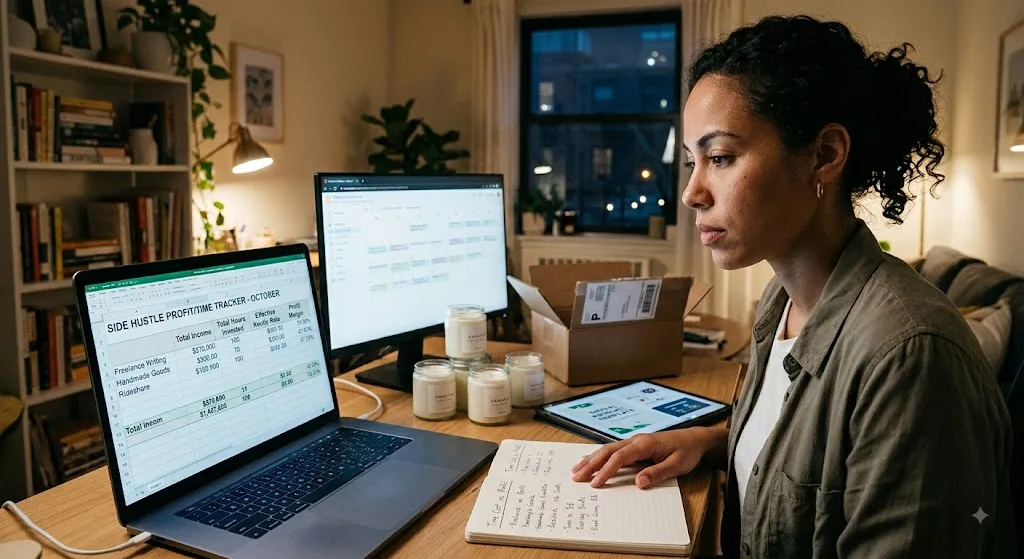
Total income ÷ total hours = effective hourly rate
For example, suppose a side hustle brings in $500 in a month.
You might think that’s a good result.
But if you spent 100 hours creating, promoting, delivering, and managing the work, you actually earned $5 per hour.
That simple calculation can eliminate many bad ideas before you waste months on them.
Side Hustles Worth Considering
There isn’t one best side hustle for everyone.
The right choice depends on your skills, available time, startup budget, and whether you want immediate income or something that could grow over time.
| Side Hustle | Startup Cost | Flexibility | Income Potential | Scalability |
|---|---|---|---|---|
| Freelancing | Low | High | High | Medium |
| Tutoring | Low | Medium | Medium–High | Low |
| Local Services | Low–Medium | Medium | Medium–High | Medium |
| Digital Products | Low | High | High | High |
| Content Creation | Low | High | Variable | High |
| Reselling | Medium | Medium | Medium | Medium |
| Online Consulting | Low | High | High | Medium |
| Handmade Products | Low–Medium | High | Medium | Medium |
The numbers aren’t guarantees. They’re simply a way to think about the trade-offs.
Freelancing: Good If You Already Have a Skill
Freelancing is one of the simplest ways to turn an existing skill into additional income.
Writing, graphic design, video editing, programming, translation, research, bookkeeping, and other professional skills can all be offered as freelance services.
The biggest advantage is that you don’t necessarily need to build a product first.
You already have the skill.
The downside is that your income is usually connected to the amount of work you can complete. If you stop working, the income usually stops too.
That’s why freelancing is often better for immediate income than long-term scalability.
Digital Products: More Work First, More Flexibility Later

Digital products can include templates, guides, educational resources, spreadsheets, design assets, or other downloadable products.
The attractive part is that you can create something once and potentially sell it multiple times.
That makes digital products more scalable than many hourly side hustles.
But there’s a catch.
Creating the product is only the beginning.
You still need people to find it, understand its value, and decide to buy it. Marketing can become a bigger challenge than creating the product itself.
Local Services: Not Glamorous, but Often Practical
Cleaning, pet care, tutoring, gardening, moving assistance, photography, and other local services aren’t necessarily exciting.
But they have one major advantage:
People already understand what they’re paying for.
You don’t need to convince someone that they need a completely new type of product.
If someone needs their house cleaned, their dog looked after, or their garden maintained, the demand is relatively easy to understand.
Local services can therefore be a practical choice for someone who wants to start earning without spending months building an audience.
Content Creation: High Potential, Slow Results
Newsletters, blogs, podcasts, video channels, and social media accounts can eventually become valuable businesses.
But they’re rarely quick money.
Building an audience takes consistency, experimentation, and patience.
You may spend months producing content before seeing meaningful income.
That doesn’t make content creation a bad side hustle. It simply means you should treat it as a longer-term project, rather than expecting immediate results.
Reselling: Simple Idea, Competitive Market
Buying something at a low price and selling it for more is one of the oldest business models around.
Today, people resell clothing, furniture, electronics, collectibles, books, and many other products.
The concept is simple.
The challenge is finding enough profitable opportunities.
You also need to consider storage, transportation, platform fees, returns, and the time required to photograph and list products.
A product that appears profitable at first can become much less attractive after all costs are included.
AI-Assisted Work: A Tool, Not a Business Model
AI tools have changed how many people approach freelance and online work.
They can help with research, writing, coding, design, organization, and repetitive tasks.
But simply using AI isn’t a side hustle.
The value comes from solving a problem for someone.
A person who uses AI to complete useful work more efficiently may have an advantage. A person who produces large amounts of generic content without understanding the subject may simply create more competition.
The important question isn’t:
“How can I make money with AI?”
A better question is:
“What useful problem can I solve faster or better with AI?”
Some Side Hustles Scale. Others Don’t.
This distinction matters.
A scalable side hustle can potentially increase its income without requiring exactly the same increase in your working hours.
A digital product is one example.
If you sell one copy, you do the work once. If you sell 1,000 copies, you don’t necessarily need to create 1,000 separate products.
Freelancing works differently.
If you charge $50 for an hour of work, earning $500 generally requires ten hours of work.
Neither model is automatically better.
A freelance business can provide excellent income, while a scalable business can take years before it becomes profitable.
The important thing is understanding what you’re building.
Ask Yourself These Questions First
Before starting a side hustle, ask yourself a few uncomfortable questions.
How much time can I realistically give it?
Not your ideal schedule.
Your actual schedule.
If you only have five hours available each week, choose something that can work within five hours.
Can I start small?
A good side hustle doesn’t always require a major investment.
Test the idea before committing significant money or time.
What problem am I solving?
People don’t usually pay simply because someone wants a side hustle.
They pay because something is useful, convenient, entertaining, faster, cheaper, or better.
Can I use a skill I already have?
Starting with something you already know can dramatically reduce the time needed to get started.
What happens if it works?
This question is often ignored.
If demand suddenly doubles, can you handle it?
If the answer is no, you may have created a job rather than a scalable business.
Will I still want to do this six months from now?
A side hustle can look exciting during the first week.
The real test comes later.
When a Side Hustle Isn’t Worth It
Sometimes the right answer is simply no.
If a side hustle constantly stresses you out, that’s information.
If it costs more money than it makes, that’s information too.
If it damages your sleep, relationships, health, or performance at your main job, the extra income may not justify the cost.
And there’s nothing wrong with stopping.
Not every experiment needs to become a business.
Sometimes the most valuable thing you gain from a failed side hustle is learning what you don’t want to do.
Don’t Confuse Revenue With Profit
One of the biggest mistakes beginners make is looking at revenue instead of profit.
Someone might say:
“I made $2,000 this month.”
That sounds impressive.
But what did it cost to make that $2,000?
If they spent $800 on materials, $300 on advertising, $200 on fees, and dozens of hours doing unpaid work, the real picture looks very different.
Always ask:
How much did I actually keep?
Then ask:
How much did I earn for each hour I invested?
Those two numbers tell you far more than revenue alone.
The Best Side Hustle May Be the One That Fits Your Life
There is no universal best side hustle.
For one person, freelancing may be ideal.
For another, tutoring might make more sense.
Someone with patience and a long-term mindset might prefer building an online audience. Someone who needs immediate income might choose a local service.
The best choice depends on what you already have:
Your skills.
Your time.
Your money.
Your energy.
Your tolerance for risk.
And your long-term goals.
Don’t choose a side hustle because everyone online says it’s easy.
Choose one because the numbers make sense for you.
Frequently Asked Questions
What is the best side hustle to start?
The best side hustle depends on your skills, available time, and financial goals. Freelancing, tutoring, local services, digital products, and content creation can all work, but they have very different time commitments and income potential.
What side hustle can I start with little money?
Service-based work, freelancing, tutoring, consulting, and some forms of content creation can be started with relatively little upfront investment.
Which side hustles have the highest earning potential?
Businesses that can scale beyond your personal working hours generally have a higher long-term ceiling. Digital products, software, content businesses, and scalable online services are examples, although none guarantees a particular income.
How do I know if a side hustle is profitable?
Calculate your total revenue, subtract all expenses, and then divide the remaining profit by the total number of hours you invested. This gives you a much clearer picture of the side hustle’s real return.
Can a side hustle become a full-time business?
Yes. Some side hustles can eventually become full-time businesses. However, it is usually wise to test demand and establish consistent income before depending on a side hustle as your primary source of money.
The Bottom Line
A side hustle is worth your time when the numbers work, the work fits your life, and the opportunity is sustainable.
Don’t look only at how much money someone claims to make.
Look at the hours behind that money.
Count the expenses.
Consider the stress.
Think about whether the work can grow.
Most importantly, don’t choose a side hustle because it is trendy.
Choose one that solves a real problem and makes sense for you.
The goal isn’t simply to make extra money.
It’s to make your extra time count.
About the Author
Ana Milojevik is a writer and contributor at Quotela.net, a general-interest publication covering business, health, technology, travel, personal development, quotes, and digital trends. She enjoys researching practical topics and creating informative content that helps readers discover new ideas, insights, and useful perspectives.
Sources
- U.S. Small Business Administration. Business Guide.
https://www.sba.gov/business-guide - Internal Revenue Service. Gig Economy Tax Center.
https://www.irs.gov/businesses/gig-economy-tax-center - U.S. Bureau of Labor Statistics. Occupational Employment and Wage Statistics.
https://www.bls.gov/oes/ - Federal Trade Commission. Business Guidance.
https://www.ftc.gov/business-guidance - U.S. Department of Labor. Independent Contractor Classification.
https://www.dol.gov/agencies/whd/flsa/misclassification/rulemaking