Is 10,000 Steps a Day a Myth?
It is the most famous number in fitness. Fitness trackers celebrate it with buzzing wrists and digital confetti, workplace wellness challenges are built around it, and millions of people feel a small pang of guilt when they finish the day at 6,000. But where did 10,000 steps come from, and do you really need to hit it to be healthy?
The short answer: the number is more marketing than science, but the habit behind it is genuinely good for you.
Where the Number Came From
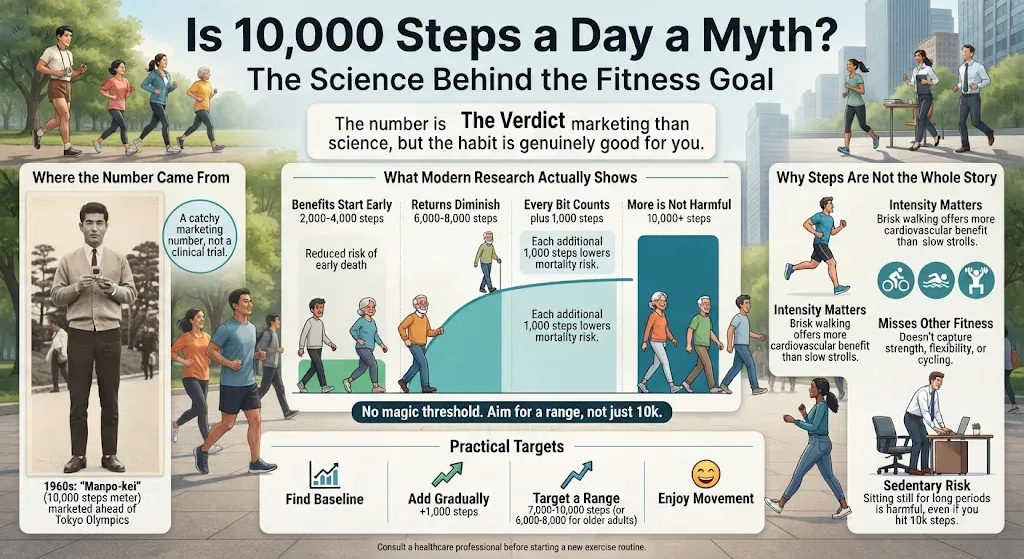
The 10,000-step target traces back to Japan in the mid-1960s. Ahead of the 1964 Tokyo Olympics, a company marketed a pedometer called the Manpo-kei, which translates roughly to “10,000 steps meter.” The figure was catchy, easy to remember, and round. It was a branding decision rather than the result of a clinical trial.
Over the following decades, the number stuck. It became a default goal in pedometers, then in smartphone apps and smartwatches, and eventually in public health messaging.
What Modern Research Actually Shows
Researchers have since put step counts under the microscope, and the findings are more encouraging than the original number suggests.
- Benefits start early. Large studies and meta-analyses have found that the risk of early death falls sharply as people move from very low activity (around 2,000 steps a day) to moderate levels.
- Returns diminish. In many studies, the biggest health gains appear somewhere between 6,000 and 8,000 steps a day, especially for adults over 60. For younger adults, the benefit tends to keep growing a little longer, often up to around 8,000 to 10,000 steps.
- Every bit counts. Some analyses estimate that each additional 1,000 steps is linked to a meaningful drop in mortality risk, and even small increases help people who are currently inactive.
- More is not harmful. Some studies show continued benefits beyond 10,000 steps, so there is no reason to stop if you enjoy walking more.
In other words, 10,000 is not a magic threshold. You do not suddenly become healthy at step 10,000, and you do not fall off a cliff at 9,999.
Why Steps Are Not the Whole Story
Step counts are a convenient proxy for how much you move, but they have limits.

Intensity matters. A brisk walk that gets your heart rate up delivers more cardiovascular benefit per step than a slow stroll. Some research suggests that walking pace is linked to health outcomes independently of total steps.
Steps miss other kinds of fitness. Cycling, swimming, and strength training barely register on a pedometer, yet they are vital. Muscle and bone health, in particular, benefit from resistance exercise that steps alone do not provide.
Sitting still is its own risk. Someone who walks 10,000 steps but spends the rest of the day seated for long stretches is not necessarily better off than someone with a more evenly spread routine. Breaking up long periods of sitting is helpful.
Individual needs differ. Age, fitness level, health conditions, and goals all change what a sensible target looks like. A person recovering from surgery and a marathon runner should not share the same number.
So What Should You Aim For?
Here is a practical way to think about it:
- Find your baseline. Check your average over a normal week without trying to change anything.
- Add gradually. Aim to increase your daily average by 1,000 to 2,000 steps, and hold that for a few weeks before pushing higher.
- Target a range, not a number. For many adults, 7,000 to 10,000 steps is a great zone. Older adults may find 6,000 to 8,000 is plenty.
- Add some pace. Include a few brisk walking bouts each day, enough that you can talk but not sing.
- Pair it with strength work. Two sessions of resistance training per week complement walking nicely.
- Keep it enjoyable. The best step goal is one you can maintain for years.
Easy Ways to Add Steps
- Take a short walk after meals.
- Get off public transport one stop early.
- Take phone calls while walking.
- Use the stairs when you can.
- Walk with a friend, a partner, or a dog.
- Park farther from the entrance.
The Verdict
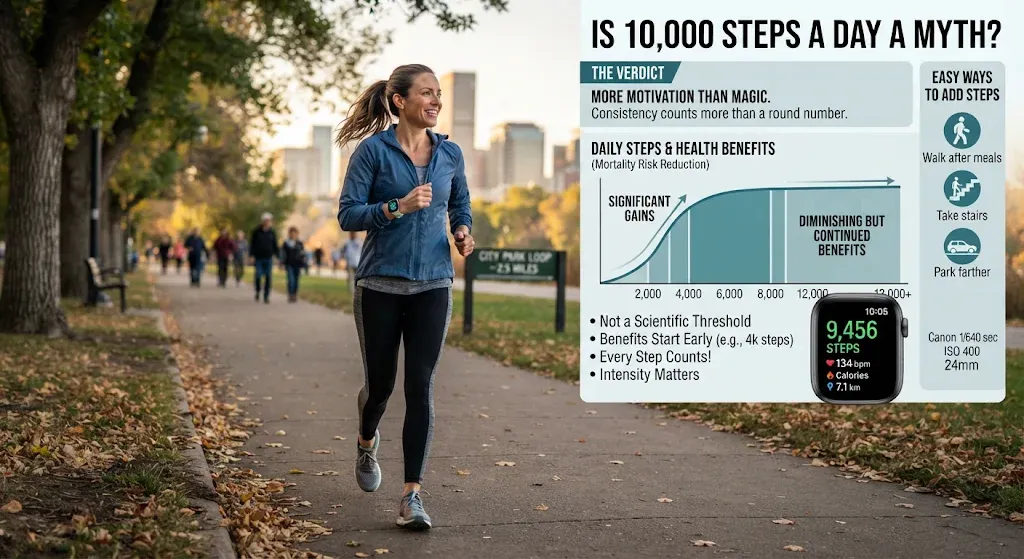
Is 10,000 steps a day a myth? As a scientifically derived target, yes, largely. As a motivational goal, it is perfectly fine. It is simply not the only number that works, and for many people it is not even the minimum needed to see real benefits.
The real message from the research is refreshingly simple: move more than you currently do, move briskly some of the time, and do not let a round number discourage you. Whether you land on 5,000, 8,000, or 12,000 steps, you are doing your body a favor.
This article is for general information and is not medical advice. If you have a health condition or have been inactive for a long time, talk to a healthcare professional before starting a new exercise routine.
Related posts:
 Which Vitamin is Most Effective for Hair? The Best Supplements for Stronger Growth
 LIFEPAK: A Lifesaving Defibrillator Series That Changed Emergency Medicine
 10 Ways to Deal with Your Stress Without Turning to Alcoholic Drinks
 Is Hizzaboloufazic Good or Bad? What You Should Know Before Trusting the Trend
 Do-Si-Dos: Why Do Colorado Tokers Love This Strain?