DAGs and Decentralized AI: How Directed Acyclic Graphs Could Transform AI
What Is the Connection Between DAGs and Decentralized AI?
Directed Acyclic Graphs (DAGs) could help enable decentralized AI by providing a structure for coordinating data, transactions, AI agents, and computational resources without relying on a single central authority. Unlike traditional blockchains, which organize transactions into sequential blocks, DAG-based systems can allow multiple transactions or events to be processed concurrently. This could make DAGs useful for decentralized AI applications that require scalable data sharing, coordination, verification, and low-latency communication.
From generating art to navigating our cities, AI is rapidly becoming the invisible hand guiding our digital lives. However, the immense power of AI is currently concentrated in the hands of a few tech giants, who control the data and the models. This centralization poses significant risks, from biased algorithms to the potential for manipulation. But what if there was a way to decentralize AI, to create a more resilient, transparent, and equitable artificial intelligence? The answer may lie not in traditional blockchain, but in its lesser-known cousin: Directed Acyclic Graphs (DAGs).
While blockchain technology has captured the public imagination with its promise of decentralization, its linear, block-by-block structure can be a bottleneck for the kind of high-throughput, low-latency data processing that AI requires. DAGs, on the other hand, offer a more organic, scalable, and efficient data structure.
A Directed Acyclic Graph (DAG) is a data structure made up of nodes and directed connections, or edges, where the connections move in one direction and never form a closed loop. In distributed systems, DAGs can be used to organize transactions, events, dependencies, or other types of information.
Unlike a traditional blockchain, which generally organizes transactions into sequential blocks, a DAG can allow multiple events to be linked and processed without requiring every transaction to wait for a single linear chain of blocks.
Depending on the protocol, this structure can allow multiple events or transactions to be processed concurrently, potentially improving throughput and reducing some of the limitations associated with strictly linear architectures.
What Is Decentralized AI?
Decentralized AI refers to artificial intelligence systems in which data, computation, model development, or decision-making is distributed across multiple participants rather than controlled entirely by one company or centralized server. Depending on the architecture, decentralized AI can involve distributed datasets, federated learning, decentralized computing networks, autonomous AI agents, or blockchain and DAG-based coordination systems.
The goal is not necessarily to eliminate centralized technology completely. Instead, decentralized AI aims to distribute control and create mechanisms for participants to contribute data or computing resources while maintaining greater transparency, verification, and user control.
DAG vs. Blockchain: What Is the Difference?
| Feature | Traditional Blockchain | DAG |
|---|---|---|
| Structure | Linear chain of blocks | Graph of interconnected events |
| Organization | Sequential blocks | Multiple linked events |
| Processing | Often constrained by block production | Can support parallel event processing |
| Scalability | Depends heavily on architecture | Can potentially improve throughput |
| Consensus | Usually a defined blockchain consensus mechanism | Varies by DAG implementation |
| Typical use | Payments, smart contracts, decentralized apps | Distributed data, transactions, coordination |
How Do DAGs Work in Decentralized AI?
A DAG organizes information as interconnected nodes and directed edges rather than a single linear chain. In a decentralized AI system, these connections could represent relationships between data contributions, transactions, computational tasks, model updates, or interactions between autonomous AI agents.
When new events are added to the network, they can reference previous events according to the rules of the particular protocol. This structure can support parallel activity and create a traceable record of interactions. However, the exact way transactions are validated, ordered, and confirmed depends on the underlying DAG implementation and its consensus mechanism.

A DAG is not automatically more decentralized, faster, or more secure than a blockchain. Performance depends on the specific protocol, consensus mechanism, network design, and implementation. The main difference is structural: blockchain systems generally organize records into a chain of blocks, while DAG-based systems organize events or transactions as a directed graph without requiring a single linear sequence.
This unique structure makes DAGs the useful foundation for a new generation of decentralized AI applications:
- Decentralized Data Marketplaces: AI models are only as good as the data they are trained on. DAGs can power decentralized data marketplaces where individuals can securely share or sell their data without sacrificing privacy. Every data point can be a node in the graph, with its usage tracked and verified by the network. This would not only provide a new revenue stream for individuals but also create more diverse and less biased datasets for training AI models.
- Verifiable and Auditable AI: One of the biggest challenges with AI is its “black box” nature. It’s often difficult to understand how an AI model arrived at a particular decision. By recording the entire lifecycle of an AI model on a DAG we can create a transparent and auditable trail. This is crucial for applications in fields like healthcare and finance, where accountability is paramount.
- AI Swarm Intelligence: AI agents could potentially coordinate through distributed networks. Imagine a world where AI agents can collaborate and learn from each other in a decentralized manner. DAGs can provide the communication and coordination layer for such a “swarm” of AIs. Each AI could be a node in the graph, sharing its insights and learnings with the rest of the network. This could lead to breakthroughs in complex problem-solving that are beyond the capabilities of any single AI.
The development of these decentralized AI systems will require a new approach to smart contracts. The traditional, rigid smart contracts of blockchain may not be suitable for the dynamic and probabilistic nature of AI. This is where the evolution of blockchain smart contract development will be critical, enabling the creation of more flexible, adaptive, and intelligent contracts that can govern the interactions of AI agents on a DAG-based network.
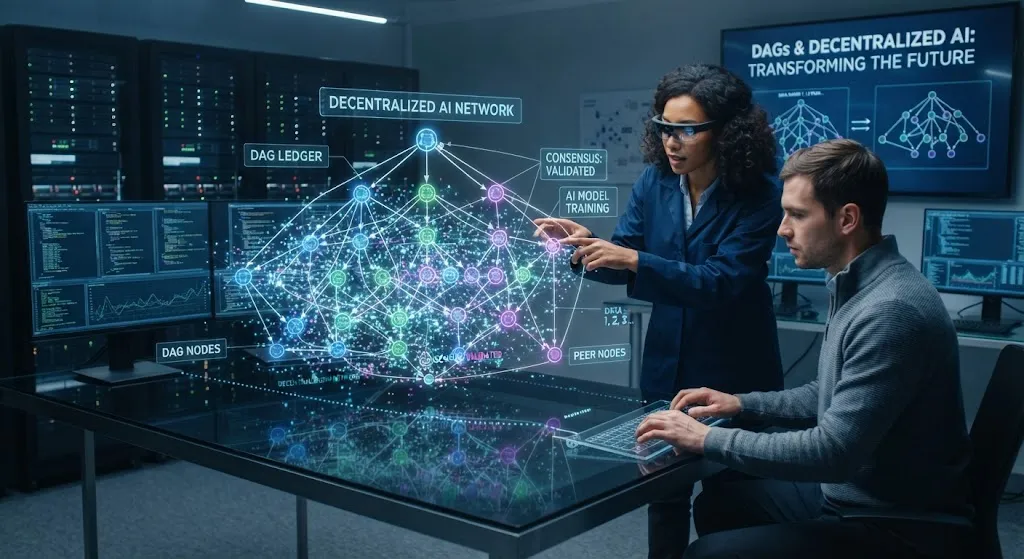
The fusion of DAG and AI is still in its nascent stages, but it holds the promise of a more democratic and intelligent future. By weaving together the threads of data, computation, and trust, DAGs could create the fabric of a truly decentralized AI, one that empowers individuals rather than corporations.
Decentralized Data Marketplaces
DAGs could support decentralized data marketplaces where individuals, businesses, and organizations share or license data without relying entirely on a single centralized platform. A DAG can record data ownership, access permissions, transactions, and usage history, creating a traceable record of how information moves through the network. This could give data contributors greater control while helping AI developers access more diverse datasets.
Verifiable and Auditable AI
DAG-based systems could create a verifiable record of important events throughout an AI model’s lifecycle, including data contributions, model updates, computational tasks, and AI-generated results. This type of record could make it easier to audit how an AI system was developed and identify where particular data or processes influenced an outcome. However, recording activity on a DAG does not automatically prove that an AI model or its output is accurate.
AI Swarm Intelligence
DAGs could provide a coordination layer for networks of autonomous AI agents that work together on complex tasks. Individual agents could contribute information, verify previous results, or build on the work of other agents without requiring one central AI system to control every interaction. In theory, this could allow decentralized AI networks to combine specialized agents for research, planning, optimization, and decision-making.
Benefits of DAGs for Decentralized AI
DAG-based architectures could offer several potential advantages for decentralized AI, including parallel processing, traceable data relationships, distributed coordination, and greater transparency. Depending on the underlying protocol, these characteristics could help AI networks coordinate large numbers of transactions, data updates, computational tasks, and autonomous agents without relying entirely on a centralized intermediary.
However, these are potential architectural benefits rather than guarantees. The actual performance, security, decentralization, and scalability of a DAG-based AI system depend on its consensus mechanism, network design, data architecture, computational infrastructure, and governance model.
Challenges of Using DAGs for Decentralized AI
Consensus Complexity
A decentralized AI network still needs a reliable way for participants to agree on which information or events should be accepted. DAG architectures can support parallel activity, but establishing consensus across a large and constantly changing network can introduce significant technical complexity.
Data Privacy
Decentralized systems can improve transparency, but transparency can also create privacy challenges. Sensitive personal or business information should not necessarily be stored publicly on a distributed network. Privacy-preserving technologies may therefore be required to control who can access particular datasets.
Computational Costs
Training and operating advanced AI models can require enormous amounts of computing power. Distributing these workloads across a decentralized network does not automatically make them cheaper. Coordinating computing resources, transferring data, and verifying results can introduce additional costs.
AI Model Verification
One of the most difficult problems is determining whether an AI model has produced a reliable result. A DAG can record that a computation occurred, but proving that the underlying model, data, and output are correct requires additional verification mechanisms.
Network Security
Decentralized networks must protect themselves against malicious participants, manipulated data, fraudulent transactions, and coordinated attacks. As autonomous AI agents become more active within these networks, securing communication between agents becomes an additional challenge.
Data Quality
Decentralizing data does not automatically make the data better. Incorrect, outdated, biased, or deliberately manipulated information can still enter a decentralized network. Effective data validation and reputation mechanisms will therefore remain essential for decentralized AI.
Governance
A decentralized AI network still needs rules governing participation, data ownership, upgrades, disputes, and harmful behavior. Designing governance that is transparent while still allowing the network to respond quickly to new problems could become one of the biggest challenges.
Scalability
AI applications can generate enormous amounts of data and computational activity. DAGs may allow more parallel processing than some traditional blockchain architectures, but that does not guarantee unlimited scalability. Network capacity, storage requirements, communication overhead, and consensus mechanisms can all become bottlenecks as participation grows.
Regulatory Uncertainty
Decentralized AI can cross borders and involve many independent participants, making legal responsibility difficult to define. Regulations concerning personal data, copyright, AI-generated content, financial activity, and automated decision-making could affect how these networks are developed and operated.
Coordination Between Autonomous AI Agents
When multiple AI agents operate independently, they need reliable ways to communicate, establish priorities, resolve disagreements, and recognize trustworthy information. A DAG could provide infrastructure for recording interactions, but additional protocols would be necessary to ensure that autonomous agents cooperate safely and predictably.
Real-World Examples of DAG-Based Networks
Several distributed networks have explored DAG-based or DAG-related architectures, demonstrating that decentralized systems do not have to rely exclusively on a conventional linear blockchain. IOTA has used a DAG-based ledger architecture for distributed transactions, while Hedera uses a hashgraph-based distributed ledger designed around asynchronous consensus. Kaspa uses a blockDAG structure that allows blocks to be created and connected in parallel rather than requiring a single chain. These projects are not, by themselves, examples of fully decentralized AI, but they demonstrate how alternative distributed architectures can be used to coordinate information and transactions.
The Bottom Line
DAGs could become an important building block for decentralized AI by helping distribute data, coordinate AI agents, record activity, and support scalable communication between participants. However, DAG technology alone cannot make AI decentralized, secure, private, or trustworthy.
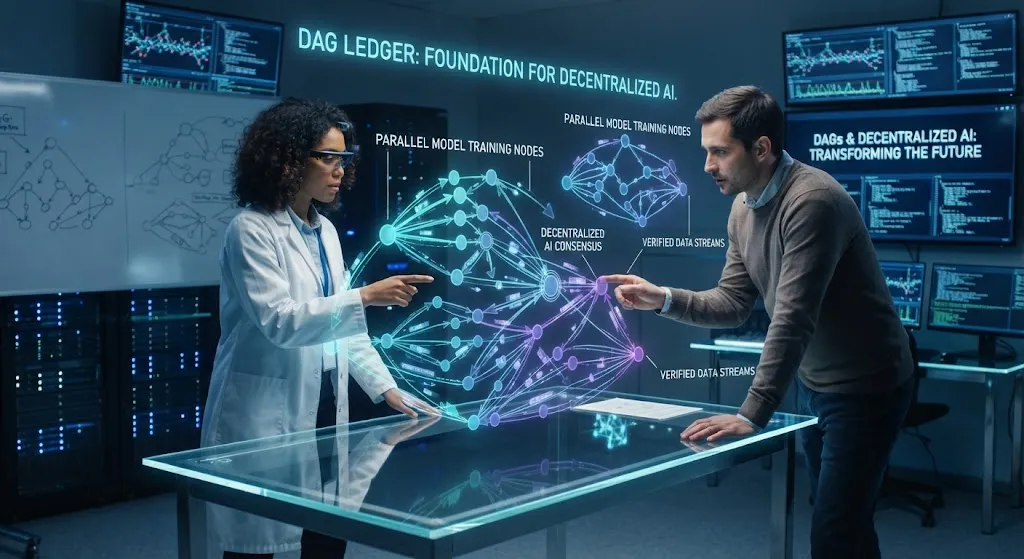
Challenges such as data quality, model verification, governance, computational costs, and network security still need to be solved. The most promising future may therefore involve combining DAG-based networks with decentralized computing, privacy technologies, cryptographic verification, and AI systems to create more transparent and distributed artificial intelligence.
Editorial Note
This article is an independent educational overview of how Directed Acyclic Graphs (DAGs) could contribute to the development of decentralized artificial intelligence. It discusses potential applications, technical challenges, and existing distributed-ledger examples to help readers understand the relationship between DAG technology and decentralized AI. The ideas presented should not be interpreted as a prediction that DAGs will necessarily become the standard infrastructure for AI.
Disclosure
This article was published on Quotela.net for informational and educational purposes. It is not financial, investment, legal, or technical advice, and it does not constitute an endorsement of any cryptocurrency, blockchain project, AI platform, or technology mentioned in the article. Readers should conduct their own research and consult qualified professionals before making financial or technical decisions based on information discussed here.
Frequently Asked Questions
What is a DAG in technology?
A Directed Acyclic Graph (DAG) is a data structure consisting of interconnected nodes and directed relationships that do not form cycles. In distributed systems, DAG-based architectures can allow information or transactions to be processed in a more parallel manner than a traditional linear blockchain.
How could DAGs help decentralized AI?
DAGs could help decentralized AI networks coordinate data, record interactions, track model activity, and allow autonomous AI agents to communicate without depending entirely on one central authority. They could potentially provide infrastructure for decentralized data marketplaces, auditable AI systems, and AI agent networks.
Are DAGs the same as blockchain?
No. A traditional blockchain generally organizes data into a sequential chain of blocks, while a DAG can organize information as a network of interconnected events or transactions. Some distributed networks use DAG-based architectures as alternatives or extensions to conventional blockchain designs.
Can DAGs make AI completely decentralized?
Not by themselves. Decentralizing the data structure or transaction layer does not automatically decentralize AI models, computing resources, data ownership, or governance. A truly decentralized AI system would require several additional technologies and mechanisms.
What are the biggest challenges for decentralized AI using DAGs?
Important challenges include consensus complexity, data privacy, computational costs, AI model verification, network security, data quality, governance, scalability, regulatory uncertainty, and coordination between autonomous AI agents.
Are DAG-based technologies already being used?
Yes. Projects such as IOTA, Hedera, and Kaspa have explored different DAG or DAG-related distributed-ledger architectures. However, using a DAG-based ledger does not necessarily mean that a project is a fully decentralized AI system.
Could DAGs improve AI transparency?
Potentially. A DAG could provide a structured record of data contributions, model updates, transactions, or interactions between AI agents. However, recording an event does not automatically prove that the underlying AI model or its output is accurate.
Why is decentralized AI important?
Decentralized AI could potentially reduce dependence on a small number of technology providers, give individuals greater control over data, increase transparency, and create new ways for independent participants to contribute computing resources and AI capabilities.
Sources
- Hedera – What Is Hashgraph Consensus? — Explains hashgraph as a DAG-based distributed consensus architecture, including gossip-about-gossip, virtual voting, Byzantine fault tolerance, security, and transaction ordering.
Hedera – What Is Hashgraph Consensus? - Hedera – How Hedera Works — Provides an overview of Hedera’s DAG-based hashgraph architecture, consensus process, gossip protocol, virtual voting, and how it differs from traditional blockchain structures.
Hedera – How Hedera Works - Hedera Knowledge Center — Contains technical papers and documentation covering hashgraph consensus, distributed ledgers, governance, privacy, and decentralized applications.
Hedera Knowledge Center - Hedera Documentation — Official developer documentation covering Hedera’s Consensus Service, decentralized applications, smart contracts, tokenization, and verifiable data.
Hedera Developer Documentation - Kaspa Documentation — Official technical documentation for Kaspa, including its DAG-based network architecture, node infrastructure, transaction data, and development environment.
Kaspa Documentation - Hashgraph Developers – Overview — Technical background on hashgraph, distributed consensus, permissioned and permissionless networks, Byzantine fault tolerance, scalability, and DAG-based architectures.
Hashgraph Developers – Technical Overview - Hedera – What Is Hedera? — Official explanation of Hedera’s public distributed ledger, hashgraph consensus algorithm, smart contracts, consensus services, and decentralized applications.
Hedera – What Is Hedera?
Updated: August 2026
Author





This is one of the clearest explanations of why Directed Acyclic Graphs are superior to traditional linear blockchains for AI. The main bottleneck for decentralized machine learning has always been the “wait time” for block confirmation. In a DAG, the asynchronous nature of transactions means we can feed data streams into a model in real-time without the network choking. I’d love to see more on how projects like IOTA or Fantom are currently pivoting toward these AI-Swarm Intelligence use cases.
The point about the “black box” nature of AI is critical. If we can use a DAG to create an immutable audit trail of training data, we solve the provenance problem. Imagine a medical AI where every diagnosis can be traced back through the graph to the specific, verified datasets that informed it. That kind of verifiable AI is the only way we’ll get mainstream adoption in regulated industries like healthcare.
I’m particularly interested in the evolution of smart contracts mentioned here. Traditional EVM-based contracts are too rigid for probabilistic AI outputs. We need “Intelligent Contracts” that can interpret data patterns on the DAG and execute based on confidence intervals rather than just binary “if-this-then-that” logic. This is the Million Dollar Ticket for the next phase of Web3.
Great mention of Swarm Intelligence. Centralized AI (like what we see from the big tech giants) is essentially a monolith. A DAG-based swarm is more like a biological brain—nodes firing independently but contributing to a collective output. It’s much more resilient to single points of failure. This is how we move from “Artificial Intelligence” to “Distributed Intelligence.”
Everyone is obsessed with “Blockchain for AI,” but they forget that a linear chain is essentially a single-lane highway. AI data processing needs a multi-lane superhighway, and that’s exactly what a Directed Acyclic Graph (DAG) provides. The way you described Swarm Intelligence really resonates—it’s the difference between a single “God-AI” controlled by a corporation and a democratic, distributed neural network. If we can solve the asynchronous consensus challenges, DAGs will be the backbone of the “Internet of Trusted Data.” Can’t wait to see how smart contract evolution handles these high-velocity data streams.
The verifiable and auditable AI section is the most important part of this piece. We currently have a “trust deficit” with AI in healthcare because we can’t always prove the provenance of the training data. By weaving a DAG into the lifecycle of a model, we create a permanent, non-linear record of every weighted decision. This isn’t just a tech upgrade; it’s a regulatory necessity for 2026. A truly decentralized AI that is transparent could literally save lives by eliminating “black box” bias in diagnostic tools.
An article that understands the latency issues with traditional blockchain! DAGs are the only structure that can scale with the speed of modern AI. The “self-validating web” is a much more organic fit for decentralized data marketplaces. Great read.
The “Swarm Intelligence” concept is the Million Dollar Ticket. We don’t need bigger models; we need smarter collaboration between smaller, specialized AIs. Using a DAG for that coordination layer is genius.
This is the missing link for AI scalability. Traditional blockchains are just too slow for the high-throughput needs of machine learning, but the asynchronous nature of DAGs changes the game. Moving from a “block” mentality to a “web” of data is how we finally achieve a truly decentralized AI without the latency bottlenecks. Great breakdown of a complex topic.