What Is the Latte Factor, and Is It a Myth?
The latte factor is a personal finance concept suggesting that small, everyday purchases can add up to significant amounts over time. Popularized by financial author David Bach, the idea encourages people to examine their spending habits and redirect money spent on unnecessary purchases toward savings, investments, or long-term financial goals.
But is the latte factor a genuine way to build wealth, or is it a myth that distracts people from bigger financial problems? The answer lies somewhere in between. Small expenses can affect a budget, but cutting a daily coffee is unlikely to solve serious financial difficulties caused by low income, high housing costs, debt, or rising living expenses.
Understanding how the latte factor works, why it attracts criticism, and when it can be useful can help you make more informed financial decisions.

Key Takeaways
- The latte factor highlights small, recurring expenses: Everyday purchases, such as coffee, snacks, and unused subscriptions, can add up to significant amounts over time.
- David Bach popularized the concept: His personal finance books encourage people to recognize spending habits and redirect money toward savings and long-term goals.
- Small savings can grow over time: Consistently saving or investing money may help build financial security through regular contributions and compounding.
- The latte factor has limitations: Cutting small expenses alone cannot solve financial difficulties caused by low income, high housing costs, or overwhelming debt.
- Not every discretionary purchase is wasteful: Affordable activities that provide enjoyment or social connection can be worthwhile when they fit within a person’s budget.
- Major expenses deserve attention: Housing, transportation, insurance, and high-interest debt may have a greater impact on financial stability than small daily purchases.
- Give your savings a clear purpose: Redirect money saved toward an emergency fund, debt repayment, retirement, or another specific financial goal.
- The best approach balances spending and saving: The latte factor works best as a budgeting tool, not as a guaranteed path to wealth. Financial decisions should reflect individual income, priorities, and circumstances.
What Is the Latte Factor?
The latte factor describes the cumulative cost of small, repeated purchases that people often make without considering their long-term financial impact.
The term is associated with David Bach, who popularized the concept through personal finance books such as The Automatic Millionaire. His central argument is that people may have more opportunities to save than they realize because seemingly insignificant daily expenses can consume money that could otherwise support their financial future.
A latte is simply an example. The same principle applies to many recurring discretionary expenses, including:
- Buying coffee or snacks every day.
- Ordering takeaway meals several times a week.
- Paying for subscriptions that are rarely used.
- Making frequent impulse purchases online.
- Buying bottled drinks when cheaper alternatives are available.
- Spending money on convenience services that provide little additional value.
Individually, these purchases may seem affordable. Their combined cost becomes more noticeable when they turn into regular habits.
For example, spending €4 on a drink five days a week might not feel particularly expensive. However, repeating that purchase throughout the year creates an expense that could potentially be reduced or redirected toward a financial goal.
The latte factor encourages people to look beyond the price of a single purchase and consider the total cost of a habit.
How Much Can Small Expenses Add Up To?
The mathematics behind the latte factor is straightforward. A recurring expense becomes a larger annual cost when multiplied by the number of times it occurs.
Consider someone who buys a €4 coffee every working day, assuming five purchases per week and 52 weeks per year.
| Period | Total spending |
|---|---|
| One day | €4 |
| One week | €20 |
| One month, on average | €86.67 |
| One year | €1,040 |
| Five years | €5,200 |
| Ten years | €10,400 |
These figures assume the price remains unchanged and the person makes 260 purchases each year.
The example illustrates why small purchases deserve attention. Although €4 may seem insignificant on its own, the cumulative cost is much larger.
Now imagine adding takeaway lunches, unused subscriptions, and frequent impulse purchases. Together, these expenses may account for a noticeable portion of a household’s discretionary spending.
However, identifying an expense does not automatically mean it should be eliminated. The important question is whether the purchase provides enough value to justify its cost.
Can Saving Small Amounts Make You Wealthy?
Saving small amounts can improve financial security, but the outcome depends on how much someone saves, how consistently they do so, their income, their starting position, and the time available.
Suppose someone redirects €100 per month toward a financial goal.
Over one year, that person contributes €1,200. Over ten years, the contributions total €12,000, excluding interest or investment returns.
If the money is invested, it may grow further through compounding. Compounding occurs when returns remain invested and can generate additional returns.
For illustration, someone who invests €100 at the end of every month for 20 years and earns a hypothetical average annual return of 5%, compounded monthly, would accumulate approximately €41,100.
The person would have contributed €24,000, while the remaining amount would represent investment growth.
This is an illustration, not a guarantee. Investment returns fluctuate, losses are possible, and fees, taxes, and inflation can reduce the final result.
The example demonstrates that consistent contributions can matter over time. However, the benefit comes from actually saving or investing the money. Spending less on coffee does not build wealth if the money is subsequently spent elsewhere.
Why Do Critics Call the Latte Factor a Myth?
Critics generally do not dispute that repeated expenses accumulate. Their objection is that the latte factor can exaggerate the importance of small purchases while overlooking larger financial pressures.
1. Small Expenses May Not Be the Main Problem
For someone struggling to pay rent, buy groceries, cover medical expenses, or meet debt obligations, eliminating a coffee purchase may make little difference to their financial position.
Essential expenses can consume most or all of a household’s income. In such circumstances, the main problem may not be unnecessary spending but the limited amount of money available after basic needs are met.
A person earning too little to cover essential costs cannot solve the underlying problem through budgeting alone.
2. Major Expenses Matter More
Housing, transportation, childcare, healthcare, and debt payments can have a much greater impact on a household budget than occasional discretionary purchases.
Consider two people who each spend €40 per month on coffee and snacks.
The first has affordable housing, manageable debt, and sufficient income to save regularly. The second faces high rent, expensive transportation, and growing credit payments.
Both could reduce their coffee spending, but the effect on their financial situations would be very different.
The second person may benefit more from reviewing major expenses, finding more affordable services, managing high-interest debt, or increasing income.
This is why financial planning should examine large expenses alongside everyday spending.
3. Investment Projections Can Be Misleading
Some versions of the latte factor use long-term investment projections to show how small daily savings could grow into substantial retirement funds.
The mathematics of compounding is valid, but projections can become misleading when they assume consistent contributions and positive returns without adequately accounting for inflation, fees, taxes, or investment losses.
A projected future balance is not the same as guaranteed wealth.
For example, €100,000 received decades from now will not necessarily have the same purchasing power as €100,000 today because inflation reduces the amount of goods and services that money can buy.
Long-term projections should therefore be treated as illustrations rather than promises.
4. Small Purchases Can Provide Real Value
The latte factor sometimes treats discretionary spending as wasteful simply because it is not essential.
However, people spend money for reasons beyond meeting basic needs. A coffee with a friend may provide social connection, a meal out may make a demanding week more enjoyable, and a hobby may improve quality of life.
The purpose of financial planning is not to eliminate every pleasure. It is to allocate money according to personal priorities and available resources.
If a daily coffee genuinely contributes to someone’s well-being and fits comfortably within their budget, there may be no compelling reason to stop buying it.
The better question is whether the expense is worth its cost to that particular person.
How to Find Your Own Latte Factor
The practical value of the concept lies in identifying recurring expenses that can be changed without sacrificing something genuinely important.
Step 1: Track your spending. Record your purchases over a representative month. Include groceries, subscriptions, dining out, transportation, and small impulse purchases. The goal is to understand where your money goes, not to judge every decision.
Step 2: Separate essential and discretionary expenses. Identify which costs are necessary and which can be adjusted more easily. Remember that what counts as essential depends on your circumstances.
Step 3: Identify purchases that provide little value. Look for subscriptions you no longer use, repeated purchases of food that goes uneaten, or convenience fees that could easily be avoided.
Step 4: Calculate the annual cost. Multiply the amount spent by how frequently the purchase occurs. For example, cancelling an unused €12 monthly subscription frees up €144 per year.
Step 5: Give the savings a purpose. Direct the money toward an emergency fund, debt repayment, retirement savings, or another specific financial goal.
Step 6: Review the results. After a few months, determine whether the changes are helping you save without making your daily life unnecessarily restrictive.
A sustainable financial plan should support your life rather than turn every small purchase into a source of guilt.
What Should You Prioritize Before Cutting Small Expenses?
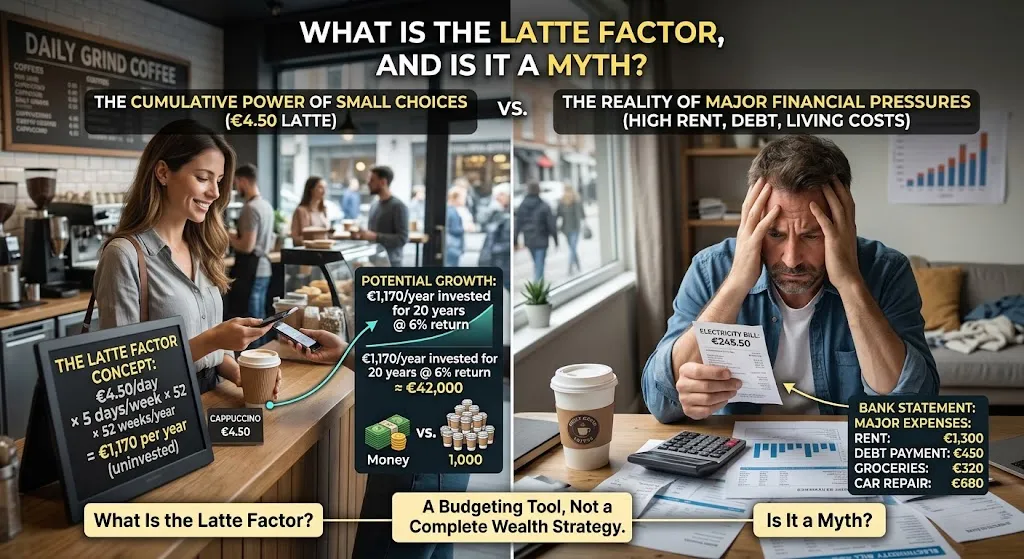
A balanced financial plan considers the entire budget and addresses the issues with the greatest consequences.
- Cover essential needs: Understand the cost of housing, food, utilities, healthcare, and necessary transportation.
- Manage high-interest debt: Expensive interest payments can undermine financial progress, so repayment may deserve priority over investing.
- Build emergency savings: Accessible savings can help cover unexpected expenses without relying on expensive borrowing.
- Review major recurring costs: Housing, insurance, transportation, and service contracts may offer opportunities for larger savings.
- Consider income opportunities: Expense reductions have limits. Where feasible, improving earning opportunities or reviewing eligibility for financial support may make a more substantial difference.
The right priorities depend on individual circumstances. Someone without emergency savings may need a different approach from someone who has manageable debt and is already saving consistently.
Is the Latte Factor a Good Financial Rule?
The latte factor is best understood as a budgeting tool rather than a complete financial strategy.
Its strength is simplicity. It encourages people to question automatic spending habits, recognize the cumulative cost of repeated purchases, and consider what else their money could accomplish.
Its weakness appears when it is presented as a universal explanation for financial hardship or a guaranteed route to wealth.
No single habit determines a person’s financial future. Income, housing costs, family obligations, debt, health, economic conditions, and unexpected events all influence financial stability.
Two people can make equally careful spending decisions and still experience very different outcomes because their circumstances differ.
A useful financial approach recognizes both personal choices and the limits imposed by external conditions. You can take responsibility for decisions within your control without assuming that every financial difficulty results from poor spending habits.
Frequently Asked Questions
What is the latte factor in simple terms?
The latte factor is the idea that small, repeated purchases can accumulate into substantial expenses over time. It encourages people to identify discretionary spending they could reduce and redirect the money toward financial goals.
Is the latte factor a myth?
The underlying mathematics is real: recurring expenses accumulate, and money saved consistently can grow over time. The myth is the suggestion that cutting small luxuries alone will make everyone wealthy or solve serious financial problems.
Who popularized the latte factor?
Financial author David Bach popularized the concept through books such as The Automatic Millionaire and The Latte Factor, co-written with John David Mann.
Does giving up coffee make you rich?
Not by itself. Reducing coffee spending may free up money, but long-term financial progress depends on how much you save, your income, debt, expenses, investment decisions, and other circumstances.
Should I stop buying things I enjoy to save money?
Not necessarily. Focus on expenses that provide little value relative to their cost. A sustainable financial plan should allow room for affordable activities and purchases that contribute meaningfully to your life.
What is the best alternative to the latte factor?
A broader financial review is more useful than focusing exclusively on small expenses. Track income and spending, examine major costs, manage debt, establish emergency savings, and choose realistic financial goals.
Conclusion
The latte factor is neither a complete financial solution nor an entirely false idea. It highlights a genuine principle: small, repeated expenses can add up, and redirecting some of that money can help improve financial security.
However, its usefulness depends on individual circumstances. Someone with unnecessary recurring expenses may benefit from reviewing and reducing them, while someone struggling to afford basic necessities may need a broader solution.
The goal is not to stop buying coffee or eliminate every small pleasure. It is to understand your spending, recognize which expenses are worth their cost, and make deliberate decisions about the money available to you.
Ultimately, the most effective financial plan is not necessarily the one that cuts the most spending. It is the one that balances present needs, meaningful enjoyment, and future security while reflecting the realities of your income and circumstances.