How Duty-Free Shops Make Money at Airports
Duty-free shops are a familiar sight at international airports around the world. Travelers passing through departure terminals often encounter stores selling perfumes, cosmetics, watches, sunglasses, alcohol, tobacco, chocolates, and luxury accessories. These products are frequently advertised as cheaper than those found in ordinary retail stores, encouraging passengers to shop before boarding their flights.
But how do duty-free shops actually make money? If customers do not pay certain taxes on their purchases, where does the profit come from?
The answer involves a combination of tax advantages, retail pricing strategies, airport rental agreements, international travel regulations, and the psychology of consumer spending. Duty-free retail is a specialized business that can generate substantial revenue when stores are located in busy airports and managed efficiently.
Key Takeaways
- Wholesale pricing drives profits: Duty-free shops buy products at wholesale prices and sell them at higher retail prices.
- Airport traffic attracts customers: Large numbers of international travelers create valuable sales opportunities.
- Tax advantages influence pricing: Applicable tax exemptions can help retailers offer competitive prices or improve margins.
- Concession fees benefit airports: Airports earn revenue through fixed fees, sales commissions, or both.
- Luxury products boost sales: Perfumes, cosmetics, alcohol, and premium accessories are popular duty-free categories.
- Operating costs determine profitability: Successful retailers must manage rent, inventory, staffing, and competition effectively.
What Does Duty-Free Actually Mean?
Duty-free shopping allows eligible international travelers to purchase certain goods without paying specific taxes or duties that would normally apply to those products in a particular market.
Depending on the country, product, and transaction, these savings may involve import duties, excise taxes, or value-added tax (VAT). The exact rules vary, and not every product is exempt from every tax.
For example, a bottle of whisky sold in a domestic store may include excise duty and VAT in its retail price. A qualifying duty-free purchase by an international traveler may be exempt from some of these charges, allowing the retailer to offer a lower price or retain a higher profit margin.
However, duty-free does not automatically mean tax-free everywhere. Travelers may still have to pay import taxes if they exceed the duty-free allowances of their destination country. Some purchases are also subject to restrictions based on age, product type, or destination.
The important distinction is that duty-free status creates a pricing opportunity, not a guarantee of profit.
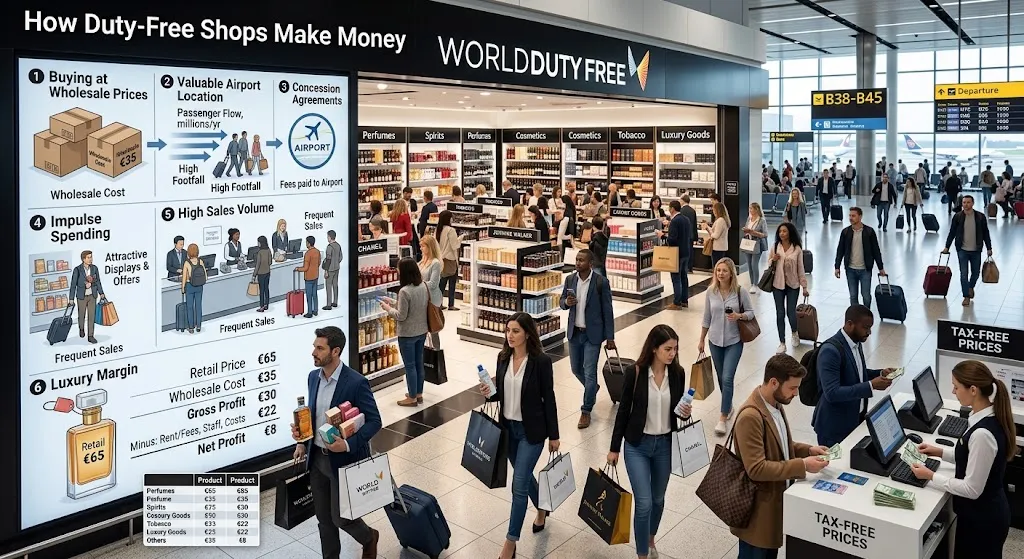
1. Buying Products at Wholesale Prices
One of the main ways duty-free retailers make money is by purchasing products from manufacturers and distributors at wholesale prices and selling them to travelers at higher retail prices.
Large airport retailers often operate across multiple countries and handle significant sales volumes. This gives them opportunities to negotiate favorable purchasing terms with international brands.
Consider a simplified example involving a bottle of perfume.
Suppose a retailer purchases a bottle for €40 and sells it for €65. The difference is €25 before other business expenses.
That €25 is the gross profit, not the final net profit. The retailer must still cover airport rent, staff salaries, security requirements, inventory management, transportation, marketing, and other operating costs.
If duty-free tax treatment reduces the final selling price, the retailer can still earn a profit as long as the difference between its purchase cost and selling price is sufficient to cover these expenses.
The most successful retailers combine competitive purchasing prices with careful product selection and strong sales volumes.
2. Airport Locations Give Stores Access to Valuable Customers
Airport duty-free shops benefit from something many ordinary retailers cannot easily reproduce: access to a concentrated flow of travelers.
Large international airports may handle millions of passengers each year. Many of these travelers pass through the same shopping areas while waiting for their flights.
This creates a potentially valuable retail environment.
Unlike a shopping street, where customers can easily walk past dozens of competing stores, an airport terminal directs passengers through designated routes toward departure gates, security areas, and boarding zones. Depending on the airport layout, travelers may encounter duty-free stores naturally as they move through the terminal.
Passengers also have waiting time that can encourage browsing. A traveler who arrives early may spend time comparing fragrances, examining luxury accessories, or buying gifts for family members.
For retailers, the combination of passenger traffic, international brands, and limited shopping alternatives can create strong sales opportunities.
However, airport access comes at a price. Retailers must compete for commercial space and pay substantial rent or revenue-based fees to airport operators.
3. Airport Concession Agreements Generate Revenue for Airports
Many duty-free stores do not own their airport locations. Instead, they operate under concession agreements that allow them to sell products inside the terminal.
These agreements are an important part of the airport business model.
An airport may select a retailer through a competitive bidding process. The winning company may agree to pay a minimum guaranteed annual amount, a percentage of sales, or a combination of the two.
For example, an agreement might require a retailer to pay the airport a minimum annual concession fee while also paying an agreed percentage of revenue above a specified threshold.
The exact terms vary considerably between airports and contracts.
This arrangement allows airports to generate commercial income beyond passenger fees and airline-related charges. Duty-free retail can therefore be an important source of non-aeronautical revenue.
For retailers, however, concession fees create a major financial commitment. A store must sell enough merchandise to cover both the cost of its products and the expense of occupying a prime airport location.
A shop with excellent passenger traffic can still struggle if its concession agreement is too expensive.
4. Travelers Often Buy More Than They Originally Planned
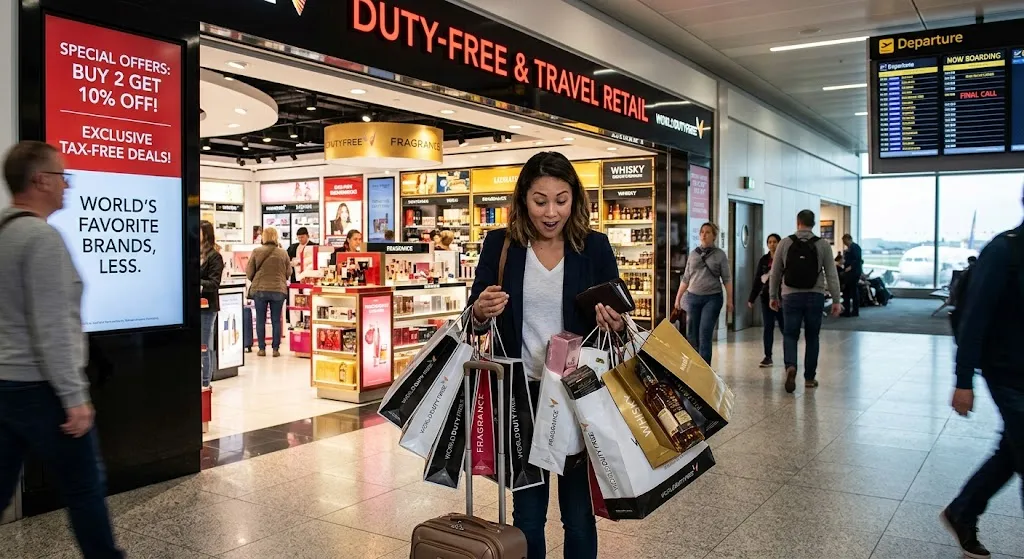
Another reason duty-free shops can be profitable is the psychology of airport shopping.
Many travelers enter an airport with a clear purpose: to catch a flight. Shopping may not be part of their original plan, but attractive displays, familiar brands, promotional offers, and the promise of tax savings can encourage additional purchases.
A passenger who intended to buy one bottle of perfume may also purchase cosmetics. Someone looking for a small gift might leave with chocolates, a watch, or a bottle of premium alcohol.
Retailers encourage these additional purchases through several techniques:
- Product displays: Expensive fragrances, cosmetics, and luxury goods are presented in visually appealing arrangements.
- Promotional bundles: Stores may offer multiple products together at an attractive combined price.
- Travel-exclusive products: Some brands sell gift sets, larger packages, or special editions designed for airport retail.
- Seasonal promotions: Holidays and peak travel periods create opportunities for gift purchases.
- Convenience: Travelers can purchase gifts and personal items shortly before departure without making a separate trip to a shopping center.
These strategies can increase the average amount each customer spends.
The business opportunity is not limited to selling essential products. It also involves encouraging discretionary purchases that travelers might not otherwise make.
5. Luxury Brands Can Produce Attractive Sales Margins
Duty-free shops frequently sell products associated with premium brands. Perfumes, skincare products, watches, sunglasses, and designer accessories can be particularly important categories.
Luxury and premium products offer several commercial advantages. Customers often recognize the brands, trust their quality, and may be willing to pay more for products associated with status or exclusivity.
Some products are also relatively small and easy to transport, making them suitable for airport retail.
Fragrances and cosmetics are especially useful examples. A traveler may be reluctant to purchase a large item shortly before boarding, but a perfume bottle or skincare gift set can fit easily into luggage or an approved shopping bag.
Nevertheless, premium products do not automatically generate the highest profit margins. Manufacturers may control distribution, wholesale prices can be high, and airport retailers may face intense competition for the right to sell popular brands.
Profitability depends on the retailer’s purchasing agreement, selling price, product mix, and operating costs.
6. High Sales Volume Helps Cover Fixed Costs
Airport retail businesses must pay for employees, store space, inventory systems, transportation, insurance, and other operating expenses. Many of these costs remain significant even when sales decline.
High sales volume helps distribute those costs across a larger number of transactions.
Imagine that a duty-free store generates €500,000 in monthly sales. If it sells more products without a proportional increase in staffing or rent, its operating efficiency may improve.
Conversely, a store in a quiet terminal may struggle to cover its expenses even if individual products have attractive gross margins.
Passenger numbers are therefore crucial. Retailers monitor flight schedules, passenger demographics, seasonal travel patterns, and spending behavior to determine which products to stock and how much inventory to maintain.
They may also adjust staffing levels to match busy departure periods and reduce unnecessary expenses during quieter hours.
Effective inventory management is particularly important because unsold products tie up money that could otherwise be used elsewhere in the business.
7. Duty-Free Retailers Use Data to Choose Products
Modern airport retail is increasingly driven by sales data and customer analysis.
Retailers study which products sell best, how much different passenger groups spend, and how purchasing patterns vary by destination or season.
For example, an airport serving many long-haul international passengers may have strong demand for premium gifts and internationally recognized brands. An airport with a high proportion of regional travelers may require a different product mix.
Retailers also analyze sales by store location, time of day, product category, and promotional campaign.
This information helps businesses decide:
- Which brands deserve the most shelf space.
- How much inventory should be ordered.
- Which products should be discounted.
- Where premium displays should be placed.
- How to reduce waste and unsold stock.
Data-driven decisions can improve profitability by helping stores invest in products that customers are most likely to purchase.
8. Not All Duty-Free Purchases Are Equally Profitable
The duty-free industry includes many product categories, but their economics can differ considerably.
| Product category | Business opportunity | Main challenge |
|---|---|---|
| Perfumes and cosmetics | Recognizable brands, gift sets, compact products | Strong competition and brand pricing policies |
| Alcohol | Popular gifts and premium products | Excise rules, weight, and import allowances |
| Tobacco | Established demand among eligible travelers | Strict regulation and declining demand in some markets |
| Chocolates and confectionery | Convenient gifts and impulse purchases | Lower selling prices and product handling |
| Watches and luxury goods | High-value transactions | Expensive inventory and potentially slower sales |
| Electronics and accessories | Useful travel products | Strong online and domestic retail competition |
A product with a high selling price does not necessarily deliver the greatest profit. Retailers must consider purchase costs, sales frequency, storage requirements, shrinkage, and the amount of capital tied up in inventory.
A relatively inexpensive product that sells consistently may contribute more to the store’s overall financial performance than a costly item that remains on display for months.
9. Online Pre-Ordering Creates Additional Opportunities
Some airport retailers allow passengers to browse products online and reserve purchases before traveling.
Customers may collect their orders at a designated airport location or follow the retailer’s instructions for collection and delivery, depending on the service offered.
This approach offers several advantages.
First, customers can compare products before arriving at the airport. Second, retailers gain earlier information about demand. Third, pre-orders can reduce the time customers spend searching for items inside the store.
Online reservations may also help retailers plan inventory more efficiently and promote products to travelers who would otherwise overlook them.
Digital services do not eliminate the costs of airport retail, but they can connect physical stores with customers before their journeys begin.
10. The Business Still Faces Significant Risks
Despite its advantages, duty-free retail is not a guaranteed source of high profits.
The industry depends heavily on international travel. When passenger numbers fall because of economic downturns, health emergencies, geopolitical instability, or travel restrictions, sales can decline rapidly.
Other challenges include:
High concession fees. A retailer may commit to substantial payments even when passenger traffic falls below expectations.
Changing consumer behavior. Travelers increasingly compare prices online before purchasing products at airports.
Regulatory restrictions. Tax exemptions, customs allowances, and product rules vary by country and can change.
Currency fluctuations. International retailers may purchase goods in one currency and sell them in another, creating exchange-rate risks.
Competition. Airport stores compete with other duty-free retailers, domestic shops, online merchants, and luxury boutiques.
Inventory costs. Products that fail to sell can tie up capital and eventually require discounts.
Successful operators must therefore balance attractive retail opportunities with disciplined financial management.
A Simple Example of How a Duty-Free Shop Makes Money
Consider a hypothetical airport store that sells a perfume for €70.
Assume the following amounts for one sale:
| Item | Amount |
|---|---|
| Selling price | €70 |
| Product purchase cost | €38 |
| Gross profit | €32 |
| Allocated operating expenses | €20 |
| Operating profit before other expenses | €12 |
In this example, the retailer earns €32 in gross profit and €12 in operating profit before any additional expenses not included in the calculation.
These figures are illustrative, not industry averages. Actual costs and margins vary by product, airport, retailer, and concession agreement.
The example demonstrates an important principle: a duty-free shop makes money from the difference between its sales revenue and its total costs, not simply from the taxes customers avoid paying.
Tax advantages may allow a retailer to offer competitive prices, but profitability still depends on purchasing costs, sales volume, concession fees, and operational efficiency.
Conclusion
Duty-free shops make money by combining international retail, favorable purchasing arrangements, tax-related pricing advantages, and access to large numbers of travelers.
Their business model relies on selling products at prices that attract customers while generating enough revenue to cover inventory costs, airport concession fees, employee salaries, and other expenses.
Airport operators also benefit because concession agreements can generate substantial commercial income from retail space.
Ultimately, duty-free shopping is much more than a system for selling products without certain taxes. It is a specialized retail industry built around passenger traffic, brand recognition, consumer psychology, and careful cost management.
The most successful duty-free retailers understand that a busy airport creates an opportunity, but only efficient operations and sound commercial decisions turn that opportunity into profit.
Frequently Asked Questions
Duty-free shops make money by purchasing products at wholesale prices and selling them to travelers at higher prices, while managing operating costs and benefiting from applicable tax exemptions.
No. Prices vary by product, brand, airport, and destination. Some items may be cheaper in regular retail stores or online.
They are usually operated by specialized retail companies under concession agreements with airport operators.
Airports typically earn revenue through fixed concession fees, a percentage of sales, or a combination of both.
Popular categories include perfumes, cosmetics, alcohol, tobacco, chocolates, and luxury accessories, although demand varies by airport and passenger type.