Lawyer vs Solicitor Difference Explained
If you have ever searched lawyer vs solicitor difference after seeing both terms used online, you are not alone. The confusion usually starts when someone in the US says lawyer, someone in the UK says solicitor, and both seem to be talking about legal help. They are related terms, but they are not always interchangeable.
The short answer is this: in the UK, a solicitor is a specific type of legal professional, while lawyer is a broader, more general term. In the US, solicitor is rarely used in everyday legal life the same way it is in England and Wales, so lawyer becomes the default term. That is why this topic can feel more confusing than it should.
Lawyer vs solicitor difference at a glance

A lawyer is a broad term for someone trained and licensed in law. A solicitor is a particular kind of lawyer in certain legal systems, especially in England and Wales. So every solicitor is generally a lawyer, but not every lawyer is a solicitor.
That distinction matters most when you are hiring legal help, reading legal content from another country, or trying to understand professional titles. If you use the wrong term in casual conversation, it usually does not cause a problem. If you are choosing someone to handle a property purchase, divorce, visa issue, or business dispute, the difference becomes more practical.
What is a lawyer?
Lawyer is the umbrella word. It describes a person who practices law, gives legal advice, represents clients, or works in the legal profession. In the US, attorney and lawyer are the most common terms. In the UK, lawyer is still understood, but it is often used as a general label rather than a formal job title.
That broader meaning is what causes the overlap. A solicitor can be called a lawyer. A barrister can also be called a lawyer. Even some in-house legal professionals may use lawyer as the simpler public-facing term because it is easier for non-specialists to understand.
So if someone says they are a lawyer, you often need one more piece of information: what kind of legal work do they actually do?
What is a solicitor?
A solicitor is a legal professional, mainly associated with England and Wales, who typically handles client advice, legal paperwork, transactions, negotiations, and case preparation. Solicitors are often the first point of contact when someone needs legal help.
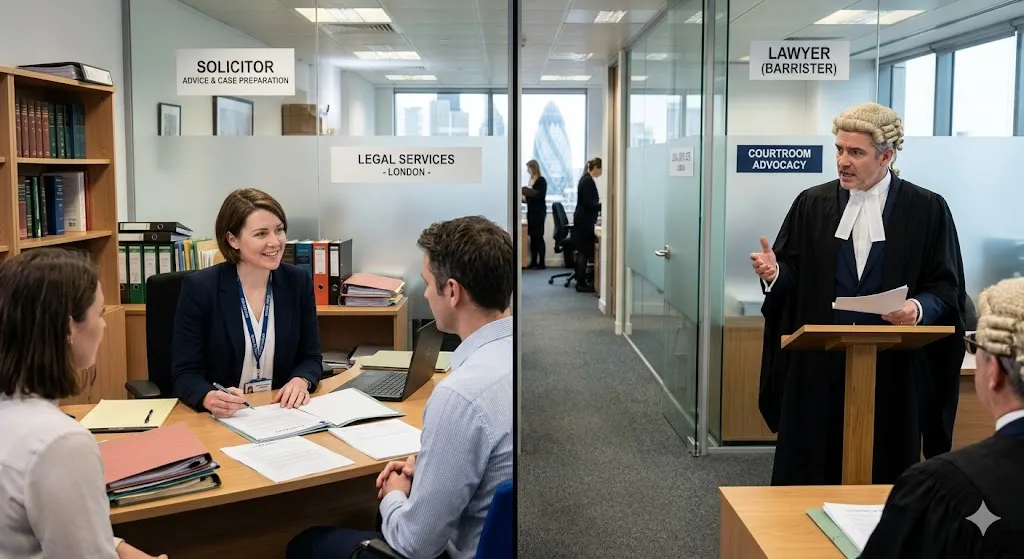
They commonly work on matters such as buying or selling property, writing wills, employment disputes, family law issues, immigration matters, and business contracts. They may also prepare a case for court, although historically courtroom advocacy in higher courts was more closely associated with barristers.
That said, modern legal practice is more flexible than many old explanations suggest. Some solicitors do appear in court, and some have advocacy rights in higher courts depending on their qualifications. So the old-fashioned idea that solicitors never go to court is too simple.
The UK legal system is why the terms differ
To understand the lawyer vs solicitor difference clearly, it helps to know that the UK legal profession has traditionally divided roles more than the US system does.
In England and Wales, the legal profession has long been split between solicitors and barristers. Solicitors usually deal directly with clients and manage the legal matter from the front end. Barristers have traditionally focused more on advocacy, specialist opinions, and representation in higher courts.
In the US, that split does not work the same way. Most people use lawyer or attorney for legal professionals across many functions. Because of that, American readers often assume solicitor must mean the same thing everywhere, when it really depends on the jurisdiction.
Scotland and Northern Ireland add another layer, because legal titles and systems are not identical across all parts of the UK. So context matters a lot.
Solicitor vs barrister vs lawyer
This is where many readers get stuck. Lawyer is the general category. Solicitor and barrister are more specific UK legal roles within that category.
A solicitor often handles the day-to-day legal relationship with the client. A barrister is more likely to be brought in for specialist court advocacy or complex legal opinions. In many cases, a client may first go to a solicitor, and that solicitor may then instruct a barrister if needed.
But legal services have evolved. Some solicitors now handle advocacy themselves, and direct access to barristers exists in some situations. So while the traditional split still helps explain the system, real life is not always that neat.
When the difference actually matters
If you are reading articles, the terms may seem interchangeable enough. If you are hiring someone, the details matter.
For example, if you are buying a home in England, you will likely look for a solicitor or licensed conveyancer, not just any lawyer. If you need ongoing business contracts reviewed, a solicitor may be the practical choice. If your matter is headed into a specialized court dispute, a barrister may become part of the picture.
For Americans dealing with UK legal matters, this can be especially relevant. Searching for a lawyer may still lead you to the right person, but checking their exact title, qualifications, and area of practice is the smart move.
Common situations where you might need a solicitor
A solicitor is often the right fit for everyday legal needs that require advice, documentation, and process management. That includes property transactions, probate, divorce, child arrangements, employment claims, debt issues, and immigration applications.
Businesses also use solicitors for company formation, shareholder agreements, commercial leases, mergers, compliance questions, and dispute prevention. In many of these situations, the best value is not dramatic courtroom representation. It is careful guidance before problems grow.
That is worth remembering. Good legal help is often about prevention, not just reaction.
Is a solicitor the same as an attorney?
Not exactly. Attorney is the common US term for a licensed legal professional who can act on behalf of a client. Solicitor is a UK-specific title tied to a particular legal profession structure.
They can overlap in the sense that both offer legal services, but they are not direct one-to-one labels across countries. If you are comparing systems, think of lawyer as the safest broad term, then narrow down from there based on jurisdiction.
Why online definitions can be misleading
A lot of quick definitions flatten the issue too much. You will often see lines like solicitors give advice and barristers go to court. That is useful as a starting point, but it misses modern practice.
Today, legal work is more blended. Some solicitors have rights of audience in higher courts. Some barristers work more directly with clients than they once did. Large law firms may also structure teams in ways that blur old assumptions.
That does not mean the distinction has disappeared. It just means you should treat simple definitions as orientation, not the whole map.
How to choose the right legal professional
Start with the problem, not the title. If you need help with a personal or business legal issue in England or Wales, look for someone who regularly handles that type of matter. Their specialization, experience, and regulatory status matter more than whether you began your search with the word lawyer.
Ask what kind of cases they handle, whether they will personally manage your matter, what court experience they have if relevant, and whether another specialist may need to be involved. A clear answer beats an impressive title.
This is one of those areas where confidence helps. You do not need to know every legal label before making contact. You just need enough understanding to ask better questions.
The simplest way to remember the lawyer vs solicitor difference
If you want the easy version, remember it like this: lawyer is the big category, solicitor is one role inside it in certain legal systems. In everyday conversation, people may blur the two. In legal practice, the distinction can shape the kind of help you get.
That makes this less about vocabulary and more about fit. The right legal professional is the one qualified for your issue, in your location, with experience that matches the stakes involved.
Legal language can make ordinary people feel one step behind, but it does not have to. Once you understand the basics, the terms stop sounding intimidating and start becoming useful. And that is usually the moment better decisions begin.
FAQ
What is the difference between a lawyer and a solicitor?
A lawyer is a general term for legal professionals, while a solicitor is a specific type of lawyer who usually provides legal advice, prepares documents, and works directly with clients.
Is every solicitor a lawyer?
Yes. A solicitor is a lawyer, but not every lawyer is a solicitor because legal systems use different professional titles and roles.
Do solicitors go to court?
Solicitors may handle some court matters, but in certain legal systems, courtroom advocacy is often performed by barristers.
Which countries use the term solicitor?
The term solicitor is commonly used in countries such as the United Kingdom, Ireland, and Australia.
Should I hire a lawyer or a solicitor?
The right choice depends on your legal needs and your country’s legal system. Some matters require general legal advice, while others may need specialized representation.
About the Author
Ana Milojevik is a writer and contributor at Quotela.net, a general-interest publication covering business, health, technology, travel, personal development, quotes, and digital trends. She enjoys researching practical topics and creating informative content that helps readers discover new ideas, insights, and useful perspectives.