What Are Online Slots? How They Work, Odds, RTP and Popularity Explained
Online slots are digital casino games based on the classic slot machines found in land-based casinos. Instead of pulling a physical lever, players choose a bet and press a button to spin virtual reels on a website or mobile app.
The goal is simple: symbols land on the reels, and matching combinations can trigger a payout according to the game’s rules. But behind the colourful graphics, bonus rounds, and jackpot animations, online slots use software, probability, and a mathematical system that determines how the game pays over time.
This beginner’s guide explains what online slots are, how they work, why they are popular, what the odds mean, and what to check before playing.
Quick answer: Online slots are digital reel-based casino games. Every spin is determined by a random number generator (RNG), and players win when symbols land in combinations listed in the game’s paytable. The outcome of each spin is independent, so no strategy or timing can guarantee a win.
What Are Online Slots?
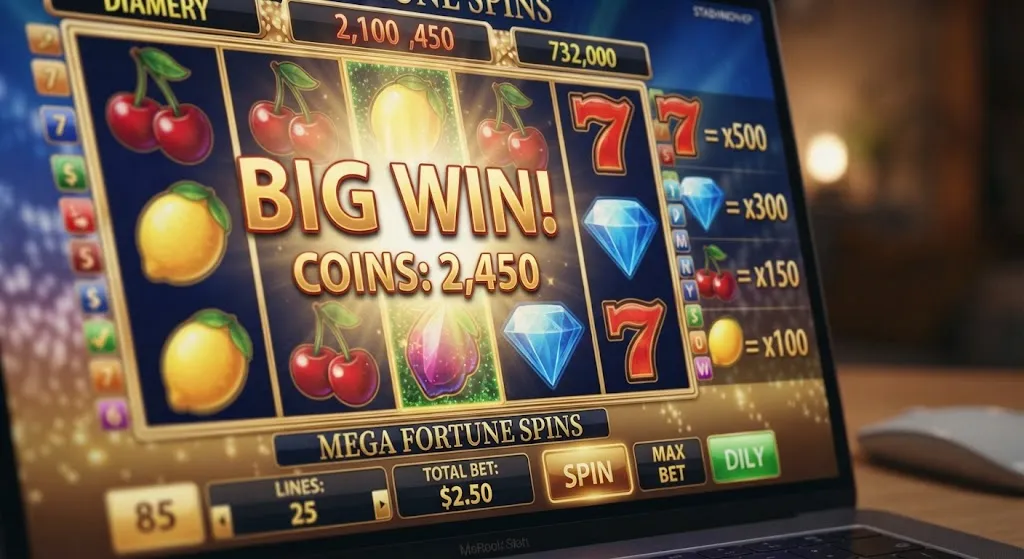
Online slots are the internet and mobile versions of slot machines. Traditional slots use physical reels, buttons, lights, and sometimes a lever. Online slots recreate that experience with animated reels, themed symbols, sound effects, and interactive bonus features.
Most modern games have:
- Three, five, or more reels
- Rows of symbols
- Paylines or “ways to win”
- A minimum and maximum bet
- Wild and scatter symbols
- Bonus rounds or free spins
- An RTP percentage
- A volatility rating
Themes vary widely. A slot might be based on ancient Egypt, mythology, fruit machines, adventure, fantasy, sports, movies, or simple classic casino symbols.
The basic principle is still the same: choose a stake, spin the reels, and see whether the symbols create a winning combination.

How Do Online Slots Work?
Online slots may look simple, but every game operates through software known as a Random Number Generator, or RNG.
The RNG continuously creates number sequences. When you press the spin button, the game uses a randomly generated result to determine the stopping position of each virtual reel. The symbols you see on screen are then displayed as an animation of that already-determined result.
This means:
- Every spin is independent.
- A previous loss does not make a future win more likely.
- A previous win does not make the next spin less likely to win.
- There is no “hot” or “cold” slot in a licensed RNG-based game.
- Pressing spin at a specific moment does not improve your odds.
In a properly licensed game, the casino cannot manually decide that a particular player must lose a specific spin. The game’s pre-set mathematics and RNG determine outcomes over the long run.
How to Play Online Slots
The exact layout changes from game to game, but the usual process is straightforward.
1. Choose a slot game
Select a game from the casino lobby or try a demo version where available. Beginners may prefer a game with simple controls, a clear paytable, and a low minimum stake.
2. Open the paytable
Before betting, look for the Info, Help, or Paytable button. It explains:
- Symbol values
- Winning combinations
- Number of paylines or ways to win
- Wild and scatter functions
- Bonus-round rules
- RTP percentage
- Maximum win
This is the most important screen in the game. It tells you how the slot actually works.
3. Set your bet
Choose how much you want to wager on each spin. The bet size affects the value of any payout but does not change the underlying RTP or improve the odds of a winning combination.
4. Press spin
The RNG determines the result immediately. The reels then animate and stop on the symbols linked to that result.
5. Check for wins or features
If matching symbols land on active paylines or qualifying “ways,” the slot pays according to its paytable. Certain symbols can also trigger free spins, multipliers, bonus games, or other features.
Reels, Paylines and Ways to Win
To understand online slots, it helps to know a few basic terms.
Reels
Reels are the vertical columns that spin. A classic slot may have three reels, while many modern video slots have five or more.
Rows
Rows run horizontally across the screen. A standard five-reel slot often displays three rows, creating a 5×3 grid.
Paylines
A payline is a pattern across the reels that can create a winning combination. Older slots may have one, five, or 20 fixed paylines. Modern games can have dozens or hundreds.
For example, a five-reel game might pay when matching symbols land from left to right across a horizontal line.
Ways to win
Some games do not use traditional paylines. Instead, they use “ways to win,” where matching symbols pay as long as they appear on adjacent reels from left to right.
A slot may advertise 243, 1,024, or even tens of thousands of ways to win. More ways do not automatically mean better odds; they simply describe how the game evaluates possible winning combinations.
What Are Wilds and Scatters?
Most online slots use special symbols that make gameplay more interesting.
Wild symbols
Wilds can substitute for other symbols to complete winning combinations. Think of them as a joker card in a deck of cards.
Some wilds may expand to cover an entire reel, stay in place for several spins, or include a multiplier that increases a payout.
Scatter symbols
Scatters usually trigger bonus features when enough appear anywhere on the reels. Unlike standard symbols, they often do not need to land on a payline.
A common example is three scatter symbols unlocking a free-spins round.
Bonus symbols
Some games use dedicated bonus symbols to activate pick-and-win rounds, jackpot wheels, special reel sets, or other features. Always check the paytable because each game handles these differently.
What Is RTP in Online Slots?
RTP stands for Return to Player. It is the theoretical percentage of all wagered money that a slot is designed to return to players over a very large number of spins.
For example, a game with 96% RTP is designed to return an average of $96 for every $100 wagered across millions of spins. The remaining 4% is the game’s theoretical house edge.
However, this does not mean a player who spends $100 will receive exactly $96 back. A single session is much too short for RTP to behave like a guarantee.
You could win more than you wager, lose your full budget quickly, or finish somewhere in between. RTP describes the game’s long-term mathematical return, not the outcome of one person’s session.
Is 96% RTP good?
Many online slots fall in the mid-90% range. As a general comparison point:
| RTP range | General meaning |
|---|---|
| Below 94% | Lower theoretical return |
| 94%–95.9% | Average to below average |
| 96%–96.9% | Commonly considered a solid range |
| 97% or higher | Higher theoretical return |
If you are comparing similar games, a higher RTP is usually preferable. Still, RTP is only one factor. You should also consider volatility, game features, bet size, and whether the game fits your entertainment budget.
What Is Slot Volatility?
Volatility, sometimes called variance, explains how a slot distributes its payouts.
Two games can have the same 96% RTP but play very differently.
- A low-volatility slot may deliver smaller wins more often.
- A medium-volatility slot may mix smaller wins with occasional larger payouts.
- A high-volatility slot may pay less frequently but offer the possibility of bigger wins.
RTP answers, “How much is the game designed to return over the long term?” Volatility answers, “How might that return be spread across individual spins?”
High-volatility slots can be especially unpredictable. A player may experience long periods without a significant win, even if the game has a competitive RTP.
What Are the Odds of Winning at Online Slots?
The chances of winning depend on the specific game. Every slot has its own reel layout, symbol frequencies, paytable, RTP, volatility, and bonus mechanics.
There is no universal win probability that applies to every online slot.
A few important points to remember:
- Each spin is random and independent.
- The game does not remember previous losses.
- No betting system changes the game’s RTP.
- A large jackpot is usually much harder to hit than a small symbol win.
- A high RTP does not guarantee short-term success.
The symbols on an online slot are not always equally likely to appear. Behind the visual reels are virtual reel strips with weighted symbol positions. Lower-value symbols may appear more frequently, while high-value symbols and jackpot combinations appear much less often.
This is why you may see smaller wins more regularly while bigger prizes remain rare.
Are Online Slots Popular?
Yes. Online slots are among the most widely used online casino products because they are simple to access, easy to understand at a basic level, and available in many themes and formats.
In Great Britain, Gambling Commission data reported 24.4 billion online slot spins for the period covered through September 2025, alongside £747 million in slots gross gambling yield. The same release reported 4.4 million average monthly active accounts in the category during Q2.
Their popularity comes from several factors:
- Simple gameplay
- Thousands of themes and game styles
- Fast rounds
- Mobile availability
- Free demo versions at some sites
- Bonus features such as free spins and multipliers
- Low minimum bets in many games
That accessibility is also why it is important to use limits. Fast, repeated spins can make it easy to lose track of time and spending.
Can You Use Strategy to Win at Online Slots?
Online slots are games of chance. There is no strategy that can guarantee a win or overcome the built-in house edge.
Some choices can help you play more responsibly, but they do not change the odds:
- Check RTP before choosing a game.
- Understand volatility before betting.
- Read the paytable.
- Use a stake that fits your budget.
- Avoid increasing bets to recover losses.
- Do not assume a losing streak means a win is due.
- Set a time limit and a spending limit before you start.
Systems such as Martingale, Fibonacci, or doubling your bet after a loss do not change the RNG or RTP. They can increase risk by making bets grow quickly during a losing streak.
Are Online Slots Fair?
Licensed online casinos typically use games from regulated software providers. These games are usually tested by independent laboratories to verify that the RNG and game mathematics operate as stated.
Still, players should be careful about where they play.
Look for a casino that:
- Is licensed in the jurisdiction where you live
- Shows clear terms and conditions
- Makes RTP information available
- Offers responsible-gambling tools
- Uses secure payment methods
- Provides customer support
- Lists its licensing information visibly
If a site hides important information, offers unrealistic promises, or makes it difficult to find game rules, it is better to avoid it.
Online Slots and Responsible Gambling
Online slots should be treated as paid entertainment, not a way to make regular income.
Before playing, decide how much you can comfortably afford to lose. Do not use money intended for bills, rent, food, debt, savings, or other essential needs.
It can also help to:
- Set a deposit limit.
- Set a session time limit.
- Avoid playing when stressed, upset, or under pressure.
- Take regular breaks.
- Do not chase losses.
- Use self-exclusion or time-out tools if gambling feels difficult to control.
If gambling stops being enjoyable or begins causing financial, emotional, or relationship problems, seek support from a responsible-gambling service in your country.
Online Slots vs. Land-Based Slots
| Online slots | Land-based slots |
|---|---|
| Played on websites/apps | Played in casinos |
| Virtual reels | Physical/visual reels |
| Mobile access | Requires casino visit |
| Often demo versions available | Usually real-money play |
| Many game variations | Depends on casino inventory |
Final Thoughts
Online slots are digital casino games built around spinning reels, matching symbols, and random outcomes. Slots are popular because they are visually engaging, easy to start, and available on desktop and mobile devices.
But the most important thing to understand is that slots are random. RTP explains a game’s theoretical long-term return, volatility explains how payouts may be distributed, and the RNG ensures that every spin is independent.
If you choose to play, read the paytable, understand the game’s RTP and volatility, use licensed sites, and keep your budget firmly under control. A slot can be entertaining, but it should never be treated as a reliable way to make money.
Frequently Asked Questions
Online slots are digital casino games that use virtual reels and symbols. Players place a bet, spin the reels, and win if qualifying combinations appear according to the game’s paytable.
Online slots use a random number generator, or RNG, to determine every spin result. When you press spin, the RNG selects the outcome, and the game displays it through the reel animation.
No. Each spin is independent and random. A previous losing streak does not make a future win more likely.
RTP means Return to Player. It is the theoretical percentage of all money wagered that a game returns to players over a very large number of spins. A 96% RTP game has a theoretical 4% house edge.
A higher RTP generally means a lower theoretical house edge, but RTP alone doesn’t determine how frequently a slot pays or what happens during an individual session. Volatility and the game’s specific mathematics also matter. However, RTP is a long-term average and does not guarantee the outcome of an individual session.
Yes. Online slots are one of the largest online gambling categories. In Great Britain alone, regulator data reported 24.4 billion online slot spins in the period through September 2025.
No. No betting strategy can change a slot’s RNG, RTP, or house edge. Managing your budget can reduce the risk of overspending, but it cannot guarantee a profit.
About the Author
Ana Milojevik is a writer covering online casinos, casino games, gambling technology, and gaming guides. Her articles focus on explaining complex gambling concepts in clear, accessible language.
Sources
- Wikipedia – Return to Player (RTP)
Comprehensive overview of Return to Player (RTP), including its meaning and role in casino games.
https://en.wikipedia.org/wiki/Return_to_player - EGR Intel – Gambling Commission Data
Reporting on UK Gambling Commission data covering online slot activity, spin volumes, and gambling revenue in Great Britain.
https://www.egr.global/intel/news/gambling-commission-data-shows-new-online-slots-spins-and-revenue-records/ - American Gaming Association – Commercial Gaming Revenue Tracker
Industry data and performance updates covering commercial gaming and digital gaming markets in the United States.
https://www.americangaming.org/resources/commercial-gaming-revenue-tracker/ - Grand View Research – Online Casino Market Size & Share Report
Market research and analysis covering the global online casino industry, including the online slots segment.
https://www.grandviewresearch.com/industry-analysis/online-casino-market-report - PokerStars Casino – Understanding Slot Machine RTP
An explanation of slot RTP, mathematical design, and how RTP relates to the expected return of casino games.
https://www.pokerstars.com/casino/news/understanding-slot-machine-rtp-what-the-numbers-really-mean/5469/