How to Start Day Trading the Smart Way
TL;DR
Day trading involves buying and selling assets within the same day to profit from short-term price movements. Beginners should focus on learning one market, mastering one strategy, and prioritizing risk management over quick profits. Start with small position sizes, use a trading journal, follow a clear trading plan, and avoid emotional decisions. Long-term success comes from discipline, consistency, and continuous learning—not from chasing fast gains.
The fastest way to lose money in the market is to treat day trading like easy money. If you are searching for how to start day trading, the better question is this: how do you begin without blowing up your account in the first month? That shift in mindset matters more than any hot stock tip.
Day trading can be exciting, flexible, and mentally sharp. It can also be expensive, emotionally draining, and brutally honest about your habits. The people who last are usually not the boldest. They are the most disciplined.
What day trading actually means
Day trading means buying and selling a financial instrument within the same trading day. You are not holding positions overnight. The goal is to capture short-term price moves in assets like stocks, options, futures, forex, or crypto.
That sounds simple, but the pace changes everything. Small mistakes get magnified when you are entering and exiting trades quickly. Fees, slippage, and emotion matter more than beginners expect. A strategy that looks great in theory can fall apart when real money and real timing are involved.
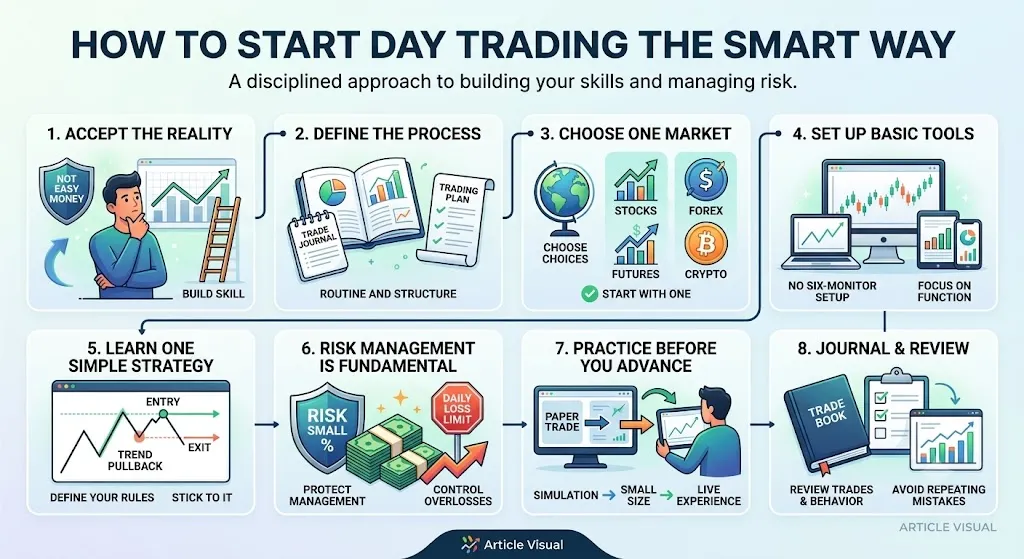
If you want to learn how to start day trading, begin by accepting one reality: this is a skill-based activity, not a shortcut to financial freedom.
How to start day trading with the right expectations
A lot of beginner frustration comes from entering with the wrong scoreboard. Many people focus on daily income from day one. A better early goal is consistency in execution. Can you follow a plan, manage risk, and avoid revenge trading after a loss?
In the beginning, progress may look boring. You might spend weeks learning chart structure, order types, position sizing, and market behavior before placing meaningful trades. That is not wasted time. It is the part most people skip, and it is often why they fail.
Expect a learning curve. Expect losing trades. Expect days where doing nothing is the best decision you make.
Choose a market before you choose a strategy
One common beginner mistake is trying to trade everything. Stocks in the morning, crypto at night, options when social media gets loud. That usually leads to scattered attention and weak decision-making.
Pick one market first. Stocks are a common starting point because they are familiar and heavily covered. Forex runs nearly around the clock and appeals to people who want flexibility, but it carries its own risks. Futures offer leverage and structure, though they can move fast enough to punish inexperience. Crypto is accessible and always active, but it can be especially volatile.
There is no perfect beginner market for everyone. The best choice depends on your budget, schedule, and risk tolerance. If you work a full-time job during market hours, certain products may fit better than others. If you have a small account, fees and minimum capital requirements may shape your decision.
Set up the basic tools you actually need
You do not need a six-monitor setup to begin. You need a reliable trading platform, a stable internet connection, real-time data if your market requires it, and a charting setup you understand.
Your broker matters because execution matters. Look for clear fees, strong platform stability, and risk controls. A flashy interface means very little if your orders lag during volatile moves.
You will also need a watchlist, a journal, and a calendar for earnings or major economic events. That may not sound exciting, but these tools often matter more than the indicators beginners obsess over.
Learn one simple strategy first
The best beginner strategy is usually the one you can explain clearly and repeat under pressure. That means clear entry rules, clear exit rules, and a defined reason to take the trade.
For example, some beginners focus on breakouts above key levels with volume confirmation. Others prefer pullbacks in a strong trend. Some trade opening range setups. The specific setup matters less than your ability to recognize it consistently.
Avoid strategy overload. If you are jumping between five systems in a week, you are not really testing anything. You are reacting.
A useful test is this: if someone asked why you entered a trade, could you answer in one sentence? If not, the setup may be too vague.
Keep your chart clean
Beginners often crowd charts with indicators because complexity feels safer. It usually does the opposite. Start with price, volume, and one or two tools that support your decision-making. The cleaner your chart, the easier it is to think.
Define the trade before you place it
Before entering, know where you will get in, where you will get out if you are wrong, and where you may take profit if you are right. If those points are unclear, skip the trade.
Risk management is the real starting line
If there is one section to take seriously, it is this one. Learning how to start day trading is really learning how not to lose too much while you get better.
Most beginners focus on how much they can make. Experienced traders focus on how much they can lose on one trade, one day, and one week. That difference is huge.
A simple rule is to risk only a small percentage of your account on any single trade. Many traders keep that number very low. This helps you survive losing streaks, which are normal, even with solid strategies.
You should also set a daily loss limit. If you hit it, stop trading for the day. This protects you from the emotional spiral that turns one bad trade into five. Discipline is easier to keep when the rule is set before the market opens.
Practice before you press harder
Paper trading can help, but only if you treat it honestly. If you take random oversized trades in a simulator, the results mean almost nothing. Use practice to build routine, test setups, and learn platform mechanics.
Then transition to very small size. Real money changes your psychology. A setup that looked easy in simulation can feel very different when profit and loss are moving live on the screen.
Starting small is not a sign of weakness. It is how you buy experience at a lower cost.
Build a routine that supports good decisions
Day trading rewards structure. You want a repeatable process before the market, during the session, and after it ends.
Before the open, review the broader market, key levels, and any news that could affect volatility. During the session, focus on your setups rather than chasing every move. After the close, review your trades and your behavior.
That last part matters. Many bad trading days are not caused by bad strategy. They come from impatience, overtrading, fear, and breaking rules after one frustrating loss.
The psychology side is not optional
This is where day trading gets personal. The market can expose impulsiveness, ego, and the need to be right. If you struggle to accept small losses, day trading will feel harder than it should.
You do not need to become emotionless. You need systems that keep emotions from running the session. That might mean preset stop losses, fewer trades per day, or stepping away after a rough start.
Confidence helps, but controlled behavior helps more. Some of the strongest trading days come from patience, not action.
How to know if day trading fits you
Not everyone should day trade, and that is a healthy conclusion, not a failure. Some people do better with swing trading or long-term investing because those approaches fit their schedule, temperament, or financial goals better.
Day trading may suit you if you enjoy fast decision-making, can follow rules, and are willing to treat it like a performance skill. It may be a poor fit if you need constant action, hate being wrong, or are trading money you cannot afford to lose.
That honest self-check can save you a lot of time and money.
Common mistakes beginners make
The biggest mistakes are usually predictable. Trading too large, switching strategies too quickly, ignoring fees, overreacting to social media, and skipping trade review are all common. So is believing a few green days mean you have figured it out.
Early success can actually be risky if it leads to overconfidence. A lucky week is not the same as a tested edge. The goal is not to feel brilliant for two days. The goal is to become steady over time.
A smarter way to begin
If you want a practical path, keep it simple. Choose one market. Learn one setup. Use a broker and platform you trust. Risk small amounts. Journal everything. Review not just what happened, but why you acted the way you did.
That approach may feel slower than the content you see online, but slow is often what keeps you in the game long enough to improve. Quotela-style optimism works best when it is attached to reality, and the reality here is clear: good trading is less about speed and more about control.
Start with respect for the process. If you can do that, you give yourself something more valuable than a quick win – a real chance to build skill.
Final Thoughts
Learning how to start day trading is less about finding the perfect strategy and more about building the habits that allow you to trade consistently over time. Success rarely comes from chasing every market move or following the latest trend. It comes from managing risk, staying disciplined, and improving one trade at a time.
Whether you choose stocks, forex, futures, or crypto, focus on creating a repeatable process rather than aiming for instant profits. Start small, keep learning, and review your decisions regularly. The traders who last are usually those who protect their capital first and let experience shape their confidence. Treat day trading as a skill that develops over time, and you’ll be in a much stronger position to grow as a trader.
Key Takeaways
- Day trading involves opening and closing positions within the same trading day.
- Begin with realistic expectations and focus on learning before trying to generate income.
- Choose one market to master instead of trading multiple asset classes at once.
- Use a reliable broker, simple chart setup, trading journal, and watchlist.
- Learn one strategy thoroughly before experimenting with others.
- Define your entry, stop-loss, and profit target before every trade.
- Risk only a small portion of your account on each position and set daily loss limits.
- Practice with paper trading before gradually transitioning to live trading with small position sizes.
- Review your trades regularly to identify strengths, weaknesses, and emotional patterns.
- Long-term success depends more on discipline, patience, and consistency than on finding the “perfect” trading strategy.
Frequently Asked Questions
How much money do I need to start day trading?
The amount depends on the market you trade and your broker’s requirements. While some markets allow you to begin with relatively small amounts, starting with sufficient capital to manage risk responsibly is generally recommended.
Is day trading good for beginners?
Day trading can be challenging for beginners because it requires quick decision-making, discipline, and strong risk management. Many new traders benefit from spending time learning, practicing, and starting with very small positions.
Which market is best for new day traders?
There is no single best market. Stocks are a common starting point due to their familiarity, while forex, futures, and cryptocurrencies each offer different opportunities and risks. Choose the market that best fits your schedule, experience, and risk tolerance.
Should I use paper trading before risking real money?
Yes. Paper trading helps you learn platform features, practice strategies, and build confidence without financial risk. However, it’s still important to transition carefully to small live trades because real money introduces different emotions.
What is the biggest mistake beginner day traders make?
One of the most common mistakes is risking too much on individual trades. Other frequent errors include overtrading, changing strategies too often, ignoring trading plans, and letting emotions drive decisions.
Can you make a living from day trading?
Some experienced traders earn a living from day trading, but it is not guaranteed and requires significant skill, experience, discipline, and risk management. Beginners should view day trading as a learning process rather than a reliable source of immediate income.
Sources
Use authoritative educational and official resources to support the information in the article:
- U.S. Securities and Exchange Commission (SEC) – Investor Education
- FINRA – Day Trading Guide and Investor Resources
- U.S. Commodity Futures Trading Commission (CFTC) – Customer Education
- Investor.gov – Investing Basics
- CFA Institute – Investor Resources
- National Futures Association (NFA) – Investor Education
Disclaimer
Disclaimer: This article is for informational and educational purposes only and should not be considered financial, investment, or legal advice. Day trading involves significant risk, including the potential loss of your entire investment. Past market performance does not guarantee future results. Always conduct your own research, evaluate your financial situation and risk tolerance, and consider consulting a qualified financial advisor before making any trading or investment decisions.
Ana Milojevik
About the Author
Ana Milojevik is a writer and contributor at Quotela.net, a general-interest publication covering business, health, technology, travel, personal development, quotes, and digital trends. She enjoys researching practical topics and creating informative content that helps readers discover new ideas, insights, and useful perspectives.