Google Flights Review Guide: Is It Worth It?
You can spend 20 minutes searching flights and still feel like you learned nothing. Prices jump, filters hide useful options, and every booking site claims it found the best deal. That is exactly why a solid google flights review guide matters – not because Google Flights is perfect, but because it can save serious time if you know what it does well and where it falls short.
One of the biggest misconceptions about Google Flights is that it helps people find cheap flights. In reality, its biggest strength is helping people avoid bad flight decisions. The cheapest itinerary is not always the best itinerary, and Google Flights often saves travelers from mistakes rather than money.
Google Flights is not an online travel agency in the usual sense. It is primarily a flight search and comparison tool that pulls in fares from airlines and travel booking platforms, then sends you out to complete the purchase.
That distinction matters. If you expect a full-service booking experience with rewards, customer support, and bundled extras, you may find it a bit thin. If you want fast search, flexible date tools, and a clean way to compare options, it is one of the best products in the category.

Google Flights review guide: what it does best
The first thing Google Flights gets right is speed. Search results load quickly, date grids update fast, and the interface makes it easy to shift airports, cabin class, and trip length without starting over. For travelers who value convenience, that alone makes it more appealing than many older comparison sites.
Its calendar and date grid tools are especially useful if your travel dates are flexible. Instead of checking one departure and return combination at a time, you can scan across several days and spot cheaper patterns almost immediately. That can make a bigger difference than hunting for a promo code.
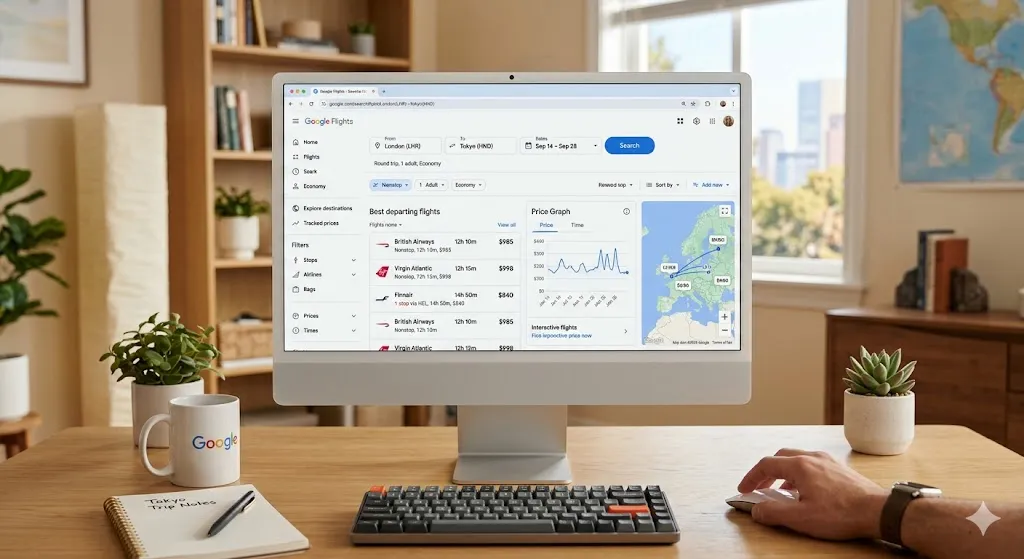
Google Flights also does a strong job with filters. You can narrow by stops, airlines, bags, times, connecting airports, price, and emissions. The emissions filter will not matter to everyone, but for some travelers it is a meaningful extra layer. More importantly, the basics are easy to understand. You do not need to be a frequent flyer to use it well.
Another advantage is the map view. If you know you want to go somewhere warm in March or somewhere affordable for a long weekend, the explore-style features help turn a vague plan into a practical one. That is where Google Flights feels less like a search engine and more like a planning tool.
A Real Example of How Google Flights Saves Time
Imagine you want to fly from Chicago to Los Angeles sometime in October.
Without flexible search tools, you might check ten different date combinations manually.
Using Google Flights’ calendar view, you can spot that leaving on Tuesday instead of Friday reduces the fare by $120. That insight appears in seconds rather than after half an hour of searching.
Where Google Flights can disappoint
No google flights review guide is complete without the trade-offs. The biggest one is that Google Flights is only as useful as the fares it can surface and the booking paths it sends you to. Sometimes that works beautifully.
Sometimes you click through and find the fare changed, the agency terms look messy, or the airline site is harder to navigate than expected.
Price accuracy is usually good, but not flawless. Flight prices can change fast across the industry, and Google Flights is not immune to stale or shifting data. If you are booking around holidays, school breaks, or major events, the gap between what you saw in search and what you see at checkout can be frustrating.
There is also a subtle limitation with budget airlines and certain regional carriers. Coverage is broad, but not always complete in every market. If you are flying in Europe, Southeast Asia, or Latin America, it is smart to compare results with at least one other source before assuming you have seen every option.
Then there is support. Because Google Flights usually redirects you elsewhere to complete the booking, it is not your main point of contact if plans go wrong.
If the airline changes your schedule or a third-party agency creates a refund headache, Google is not stepping in like a travel agent. That makes your choice of booking partner more important than many people realize.
How pricing really works on Google Flights
Google Flights is very good at showing price trends, but it is not a magic low-fare machine. It does not create discounts out of nowhere. What it does do is help you spot value faster.
The price tracking feature is one of its best tools. You can monitor a specific route and get notified when fares move. That is useful if you are planning ahead and do not need to buy today. It takes some emotion out of the process. Instead of checking five times a day and second-guessing yourself, you let the alerts do the work.
The price guidance feature can also help, though it should be treated as guidance, not gospel. When Google says a fare is low, typical, or high for your route and dates, it is giving you context based on historical pricing patterns.
That context is useful, but markets change. A fare that looks high today may become the best available option if demand spikes tomorrow.
This is where traveler goals matter. If your top priority is the absolute lowest fare, you may need to accept awkward layovers, odd departure times, or basic economy restrictions. If your priority is comfort or convenience, Google Flights can still help, but the cheapest option will not always be the right one.
Is Google Flights better than other flight search tools?
In many cases, yes – especially for ease of use. Compared with some metasearch platforms, Google Flights feels cleaner, faster, and less cluttered by ads or confusing ranking tricks. You are usually able to tell quickly whether a flight is genuinely attractive or just looks cheap until bags and seat selection get added later.
That said, better depends on what you need. Some competitors are stronger for package trips, hidden-city strategies, budget airline quirks, or loyalty program integrations. Others may surface online travel agencies with niche fares that Google does not prioritize in the same way.
For most casual travelers, Google Flights is the best starting point, not always the final stop. It is strong at narrowing the field and showing the market clearly. It is less strong as an all-in-one booking ecosystem.
Google Flights review guide for smart booking decisions
If you want to use Google Flights well, start broad and then narrow down. Search nearby airports if that is realistic for you. Even a one-hour drive can change the fare picture dramatically. Use the flexible date view before you lock yourself into fixed travel days. Small changes often save more than endless searching.
Pay attention to baggage details and fare class. A low headline fare is not automatically a better deal if it excludes a carry-on, assigns a middle seat, or charges a steep change fee. Google Flights does show many of these details, but you still need to read carefully before checkout.
When you are ready to book, consider whether you want to book directly with the airline or through an online travel agency. Direct booking often gives you cleaner support if something changes. An agency may sometimes offer a slightly lower price, but that saving can disappear quickly if you need to modify the trip.
It is also worth checking layover logic. A slightly cheaper itinerary with a short international connection might not be worth the stress. On paper it looks efficient. In real life, one delay can ruin the whole plan.
The Cheapest Flight Is Often the Most Expensive Decision
A traveler might save $60 by choosing a flight with a seven-hour layover and a 5 a.m. departure. On paper, it looks like a win.
After paying for airport food, losing sleep, and arriving exhausted, the cheaper itinerary no longer feels like a bargain.
Google Flights is useful because it lets you compare convenience and cost side by side instead of focusing only on price.
Three Types of Travelers Who Use Google Flights Differently
The Vacation Planner
This traveler knows the destination but has flexible dates. For them, Google Flights’ date grid can be worth more than any coupon code because shifting a trip by a few days sometimes saves hundreds of dollars.
The Deal Hunter
This person has no destination in mind. They simply want the best value. The Explore map often becomes the most useful feature because it reveals destinations they may never have considered.
The Business Traveler
For someone flying on fixed dates, Google Flights is less about finding the absolute lowest fare and more about quickly comparing schedules, layovers, and airport options.
Situations Where I Would Use Another Tool
Google Flights is excellent for research, but it is not always my first choice.
For complex multi-city trips, reward travel, or airline-specific promotions, I often check additional sources before booking. Some niche deals never appear in the same way on major search platforms.
That does not make Google Flights worse. It simply means every tool has blind spots.
What Google Flights Doesn’t Tell You
Google Flights is very good at comparing fares.
It is much less effective at predicting how comfortable your journey will feel.
A 45-minute connection may look efficient in search results. In reality, it could require changing terminals in a busy airport and create significant stress if the first flight arrives late.
The best flight is not always the cheapest or the fastest. Sometimes it is simply the least stressful.
Who Should Skip Google Flights?
- Travelers who only use airline miles
- People booking complex round-the-world trips
- Users who want a travel agent-style experience
- Travelers who need bundled packages
The Biggest Google Flights Myth
Many travelers believe Google Flights always finds the absolute lowest fare available online.
That is not really its purpose.
Google Flights is designed to make comparison easier, not necessarily to uncover every hidden deal. In some cases another website may show a lower fare, but finding it could require far more time and effort.
The real value of Google Flights is reducing search friction, not guaranteeing the cheapest ticket on the internet.
Who should use Google Flights
Google Flights is ideal for travelers who want a quick, intuitive way to compare flight options without getting buried in clutter. It is especially useful for flexible travelers, digital-savvy planners, and anyone who wants price alerts and calendar tools without a steep learning curve.
It is less ideal for travelers who want hand-holding, package deals, or one platform to manage everything from flights to hotels to support issues. If that is your style, you may prefer a more traditional booking experience.
For beginners, Google Flights is a confidence booster. It turns a messy search process into something more visual and manageable. For experienced travelers, it is a fast research tool that cuts through noise. That broad usefulness is a big reason it remains so popular.
So, is it worth using? Absolutely – with realistic expectations. Google Flights is excellent for search, comparison, and planning. It is not perfect on coverage, final pricing consistency, or after-booking support. But if you treat it as a smart decision tool rather than a miracle deal engine, it earns its place in your travel routine.
A good trip often starts with a clear view of your options, and that is where Google Flights shines. The better you understand the tool, the less likely you are to chase the cheapest number and regret the flight attached to it.
About the Author
Ana Milojevik is a writer and contributor at Quotela.net, a general-interest publication covering business, health, technology, travel, personal development, quotes, and digital trends. She enjoys researching practical topics and creating informative content that helps readers discover new ideas, insights, and useful perspectives.