Coinbase vs Kraken Fees: Which Costs Less?
A $100 crypto purchase can look very different by the time it lands in your account. That is why comparing Coinbase vs Kraken fees means looking beyond the number shown as a trading fee. The purchase method, trading screen, payment method, spread, and withdrawal network can all affect what you pay.
For beginners, Coinbase is often the easier platform to understand at first glance. Kraken is frequently favored by cost-conscious traders who are willing to use its more advanced tools. But neither exchange is automatically cheaper in every situation. The better choice depends on whether you are making a quick one-time buy, placing regular trades, or moving crypto off the exchange.
Coinbase vs Kraken Fees at a Glance
Coinbase and Kraken both use tiered fee structures, so the price can change based on your monthly trading activity, order type, location, and chosen product. Their beginner-friendly purchase flows may also have a different cost structure than their advanced trading platforms.
Coinbase generally offers two ways to buy. A simple purchase experience is designed for convenience, while Coinbase Advanced gives users access to order books, limit orders, and maker-taker pricing. The simple route can be more expensive because the displayed quote may include a spread along with any stated fee.
Kraken works in a similar way. Its instant-buy option is built for speed, while Kraken Pro is aimed at people who want more control over orders and a clearer maker-taker fee model. In many low-volume spot-trading comparisons, Kraken Pro has often been competitively priced, especially for traders placing limit orders.
The key lesson is simple: comparing Coinbase’s simple buy screen with Kraken Pro is not an apples-to-apples comparison. Compare simple buying with simple buying, or advanced spot trading with advanced spot trading.
The Difference Between a Fee and a Spread
A trading fee is usually shown as a percentage or dollar amount charged for executing an order. A spread is the difference between the market price of an asset and the price you are offered at the moment of purchase or sale.
This distinction matters because a platform can advertise a straightforward fee while the final quoted price still differs from the market price you saw seconds earlier. Spreads can be more noticeable during volatile periods, when crypto prices are moving quickly, or when trading less liquid coins.
Coinbase’s simple buying interface may include a spread in the quoted price, depending on the transaction. Kraken’s instant-buy experience can also include a spread or price adjustment, along with transaction costs that vary by payment method. In both cases, the final review screen is more useful than relying on a headline fee alone.
Before confirming an order, check three figures: how much cash is leaving your account, how much crypto you will receive, and the effective price per coin. That quick habit can prevent small costs from becoming an expensive pattern.
Advanced Trading Fees: Maker vs. Taker
For frequent buyers and sellers, advanced trading is usually where the Coinbase vs Kraken fee comparison becomes most meaningful. These platforms typically use a maker-taker system.
A maker order adds liquidity to the market. For example, if Bitcoin is trading at $60,000 and you place a limit order to buy only if it falls to $59,500, that order may sit on the book until someone accepts it. A taker order removes liquidity by filling immediately against an existing order, such as a market order.
Maker fees are often lower than taker fees because they help supply liquidity. Both Coinbase Advanced and Kraken Pro offer volume-based tiers, meaning the percentage generally falls as your trading volume rises over a rolling period. Exact schedules can change, so check the platform’s current rate card before trading.
For smaller spot traders, Kraken Pro has often had a cost advantage at entry-level tiers, while Coinbase Advanced can still be a sensible choice for people who value its interface, asset availability, or existing account setup. The gap may be modest on a single trade, but it matters more for active traders making multiple transactions each week.
A limit order is not guaranteed to be cheaper in every circumstance. It may not fill if the market moves away from your chosen price. If you need immediate execution, a market order may be the practical choice even if its fee is higher.
Deposit Fees Can Change the Equation
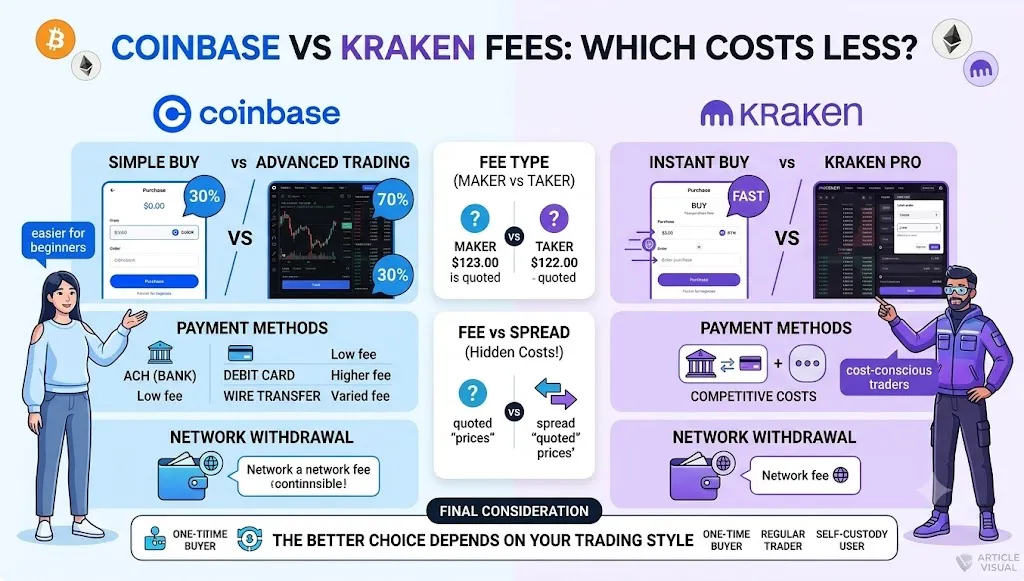
Funding your account is part of the real cost of buying crypto. ACH bank transfers are often a low-cost option for eligible U.S. customers, although availability and holding periods can vary. Wire transfers may involve charges from your bank, while debit card purchases are usually among the more expensive ways to fund an account.
Coinbase and Kraken may charge different fees depending on whether you deposit by bank transfer, card, digital wallet, or another locally available payment method. Your own bank may also add a charge, particularly for cards, international transfers, or currency conversion.
If you plan to invest a fixed amount every month, the payment method can matter as much as the exchange. A convenient card purchase may cost more each time than a planned bank transfer followed by an advanced trade. Convenience has value, but it is worth knowing what you are paying for it.
Withdrawal Fees Matter If You Self-Custody
Buying crypto is only one stage of the journey. If you move assets to a personal wallet, you will usually face a withdrawal fee. This is especially relevant for Bitcoin and Ethereum, where network conditions can affect transfer costs.
Exchanges commonly set their own crypto withdrawal fees and minimum withdrawal amounts. Those charges do not always match the exact blockchain network fee at that moment. They may be fixed for a period, adjusted periodically, or differ by asset and network.
Coinbase Fees EXPOSED!
Kraken and Coinbase each support multiple assets and, in some cases, more than one network for a token. Selecting the wrong network can be a costly mistake, so the receiving wallet must support the exact network you choose. A low withdrawal fee is only a good deal if your funds arrive safely.
For long-term investors, it can be smarter to make fewer, larger withdrawals rather than sending tiny amounts after every purchase. That approach can reduce the percentage of your portfolio lost to fixed transaction costs.
Which Platform Is Cheaper for Your Style?
Coinbase may suit you if you want a highly familiar interface, straightforward recurring purchases, and an easy path from beginner tools to an advanced trading screen. It can be a reasonable fit if you are placing occasional trades and value simplicity enough to accept potentially higher all-in costs on quick purchases.
Kraken may suit you if you are focused on spot-trading fees, intend to use limit orders, or want a more trading-oriented experience from the start. For an investor who is comfortable learning the basics of an order book, Kraken Pro can be an attractive route for keeping routine costs down.
There are trade-offs beyond price. Asset selection, availability in your state or country, account verification, security preferences, staking access, tax records, and customer support can all influence the better platform for you. A slightly lower fee does not help much if the exchange does not support the coin, payment method, or feature you need.
A Smarter Way to Compare Any Crypto Purchase
Instead of asking only, “What is the fee?” ask, “What will this transaction cost me from bank account to wallet?” Review the quoted purchase price, visible fee, payment charge, amount received, and expected withdrawal cost. Then repeat the same example on the other exchange at roughly the same time.
For instance, compare a $250 Bitcoin purchase using the same payment method on both platforms. Next, compare a $250 limit order through Coinbase Advanced and Kraken Pro. You will get a much clearer answer than you would from a generic fee table, especially when prices and spreads are moving.
The most encouraging part is that you do not need to become a day trader to make better choices. Use the platform that fits your confidence level, check the final order preview every time, and let your investing habits – not flashy convenience – decide what your crypto costs.
Conclusion
Choosing between Coinbase and Kraken is about more than finding the lowest advertised trading fee. The total cost of a crypto purchase can include spreads, payment method charges, trading fees, and withdrawal costs. A platform that looks cheaper at first glance may end up costing more once every part of the transaction is considered.
For beginners, Coinbase offers a simple and approachable experience, while Kraken often appeals to users who want lower trading costs through Kraken Pro and are comfortable using advanced order types. Rather than relying on published fee tables alone, compare identical transactions on both exchanges using the same payment method and trading interface. Looking at the complete cost from deposit to withdrawal will help you make a more informed decision and keep more of your investment over time.
Key Takeaways
- Coinbase and Kraken use different fee structures depending on the trading interface you choose.
- Compare Coinbase Advanced with Kraken Pro, not a simple buy screen with an advanced trading platform.
- Spreads can significantly affect the total cost of buying crypto, even when trading fees appear low.
- Maker orders often have lower fees than taker orders on advanced trading platforms.
- Deposit methods such as debit cards, bank transfers, and wire transfers can change your overall costs.
- Crypto withdrawal fees should be included when calculating the true cost of an investment.
- Kraken Pro is often attractive for active traders seeking competitive spot trading fees, while Coinbase prioritizes ease of use.
- Always review the final order summary before confirming a transaction to understand exactly what you will pay.
Frequently Asked Questions
Is Kraken cheaper than Coinbase?
In many cases, Kraken Pro offers lower spot trading fees than Coinbase Advanced, especially for lower-volume traders. However, the total cost depends on spreads, payment methods, withdrawal fees, and the type of order you place.
Does Coinbase charge a spread?
Yes. Coinbase’s simple buying interface may include a spread in the quoted price in addition to any displayed transaction fee. The exact amount can vary depending on market conditions and the transaction.
Which is better for beginners: Coinbase or Kraken?
Coinbase is generally considered more beginner-friendly because of its simple interface and guided buying process. Kraken offers beginner options as well, but many users choose Kraken Pro for its lower trading fees and advanced features.
Are maker fees lower than taker fees?
On most advanced trading platforms, including Coinbase Advanced and Kraken Pro, maker fees are typically lower because maker orders add liquidity to the market. Fee schedules vary by trading volume and may change over time.
Do deposit methods affect crypto buying costs?
Yes. Bank transfers are often less expensive than debit card purchases, while wire transfers may include bank fees. Your chosen payment method can have a significant impact on the total cost of buying cryptocurrency.
Should I consider withdrawal fees when comparing exchanges?
Absolutely. If you plan to move your crypto to a personal wallet, withdrawal fees are part of your total investment cost. Comparing only trading fees may not provide an accurate picture of which exchange is more affordable.
About the Author
Ana Milojevik is a writer and contributor at Quotela.net, a general-interest publication covering business, health, technology, travel, personal development, quotes, and digital trends. She enjoys researching practical topics and creating informative content that helps readers discover new ideas, insights, and useful perspectives.