Good Debt vs. Bad Debt: What’s the Difference?
Good debt helps you build wealth or increase your income, like a mortgage, student loan, or business loan, while bad debt pays for things that lose value or offer little lasting benefit, usually at a high interest rate.
That said, the labels are a guideline rather than a rule. Any debt can become harmful if the cost is too high or the repayments don’t fit your budget, so the real test is what you borrow for, how much interest you pay, and whether you can comfortably afford it.
Understanding the difference can help you make smarter borrowing decisions, protect your financial health, and plan for the future.
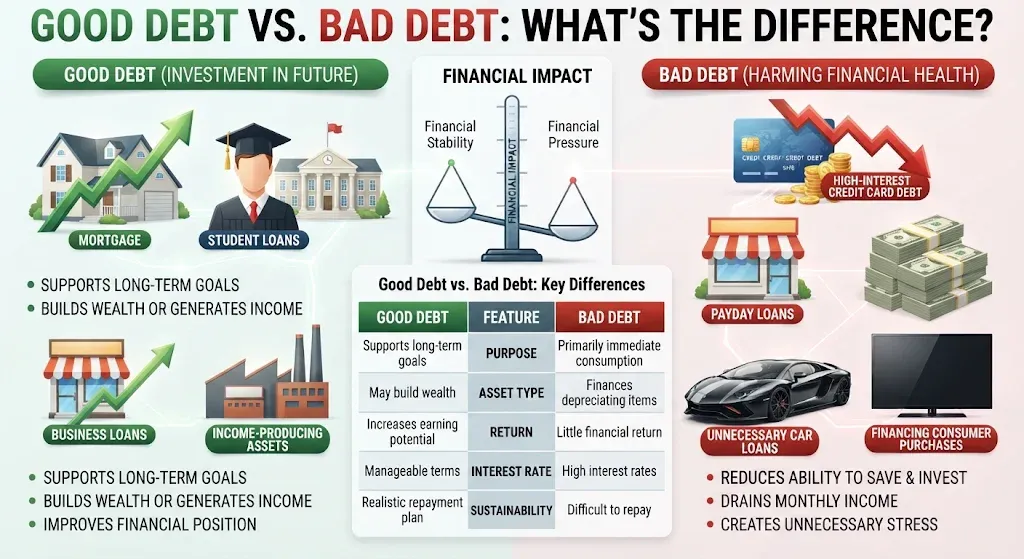
So, what makes debt good or bad? The answer generally depends on what you borrow money for, how much interest you pay, whether you can afford the repayments, and what financial benefits you receive in return.
What Is Good Debt?
Good debt is borrowing money to purchase something that has the potential to increase in value, generate income, or improve your financial position over time.
Rather than simply paying for something you want immediately, good debt is generally used as an investment in your future. When managed responsibly, it can help you access opportunities that might otherwise be difficult to afford.
However, even debt used for a worthwhile purpose is not automatically good. Interest rates, repayment terms, your income, and the overall cost of borrowing still matter.
Common Examples of Good Debt
1. Mortgage Debt
A mortgage is one of the most common examples of potentially good debt. Buying a home allows you to build equity over time as you repay your loan and, potentially, benefit from property value appreciation.
Unlike renting, homeownership can provide a long-term financial asset. However, property ownership also involves maintenance, insurance, taxes, and other expenses. A mortgage becomes a financial burden when the monthly payments are beyond your means.
2. Student Loans
Education can be a valuable investment in your future earning potential. Student loans may help cover tuition, books, and other educational expenses, allowing you to develop skills and qualifications that can lead to better employment opportunities.
The key is to consider the likely return on your educational investment. Borrowing a large amount for a degree with limited employment opportunities may create financial difficulties rather than improve your financial situation.
3. Business Loans
Borrowing money to start or expand a business can be another example of good debt. Business financing can help entrepreneurs purchase equipment, hire employees, invest in inventory, or expand operations.
If the business generates enough additional revenue to cover its borrowing costs and operating expenses, the loan may support long-term growth.
However, business loans involve risk. A business may not generate the expected income, so borrowing should be based on realistic financial projections.
4. Loans for Income-Producing Assets
Some loans are used to purchase assets that generate income, such as rental properties or certain types of business equipment.
For example, an investor might borrow money to purchase a rental property and use rental income to cover mortgage payments and other expenses.
The investment only makes financial sense if the expected income and long-term benefits justify the borrowing costs and risks.
What Is Bad Debt?
Bad debt generally refers to borrowing money to purchase things that lose value quickly, provide little or no long-term financial benefit, or are unnecessary.
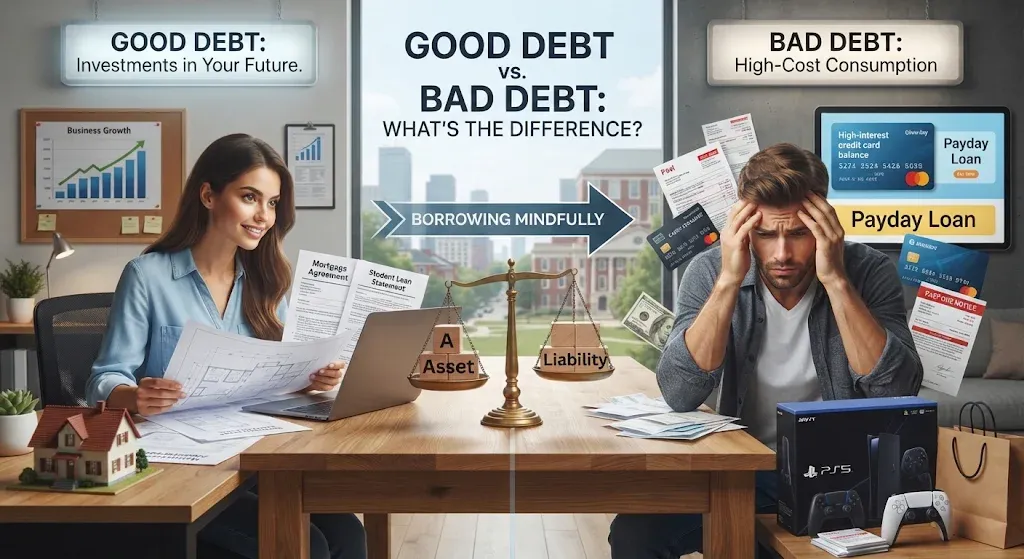
This type of debt can become particularly problematic when it carries high interest rates, involves ongoing borrowing, or is used to cover everyday expenses without a realistic repayment plan.
Unlike productive borrowing, bad debt often reduces your ability to save, invest, and achieve important financial goals.
Common Examples of Bad Debt
1. High-Interest Credit Card Debt
Credit cards can be convenient for everyday purchases, but carrying a balance from month to month can become expensive.
When you pay only the minimum amount due, interest continues accumulating on the remaining balance. Over time, you may end up paying significantly more than the original purchase price.
Credit card debt is especially problematic when you use one credit card to pay off another or regularly borrow to cover basic expenses.
2. Payday Loans
Payday loans are short-term loans that typically come with very high fees and borrowing costs.
Although they may provide quick access to cash during an emergency, their repayment terms can make them difficult to manage, particularly for people already experiencing financial difficulties.
Repeatedly taking out payday loans can create a cycle of borrowing in which each new loan makes it harder to repay previous obligations.
3. Financing Expensive Consumer Purchases
Borrowing money to purchase luxury items, expensive electronics, designer clothing, or other nonessential products can become bad debt when the purchases exceed your financial capacity.
For example, financing an expensive television over several years means you may still be making payments long after the product has lost much of its original value.
The problem is not necessarily the purchase itself but the decision to pay for it with expensive borrowed money.
4. Unnecessary Car Loans
A car can be an essential part of everyday life, particularly when you need reliable transportation for work or family responsibilities.
However, taking out a large loan to purchase a vehicle that is more expensive than you can comfortably afford may create unnecessary financial pressure.
Cars generally depreciate over time, meaning their market value decreases while the loan balance may remain relatively high.
Good Debt vs. Bad Debt: Key Differences
Although both types involve borrowing money, good debt and bad debt differ in their potential financial benefits, costs, and long-term consequences.
| Good Debt | Bad Debt |
|---|---|
| Supports long-term financial goals | Primarily funds immediate consumption |
| May help build wealth or generate income | Often finances depreciating purchases |
| Can improve earning potential | Usually provides little financial return |
| Often has more manageable borrowing terms | Frequently involves high interest rates |
| Is supported by a realistic repayment plan | Can become difficult to repay |
| May strengthen financial stability | Can weaken financial stability |
The distinction is not always straightforward. A mortgage, student loan, or business loan can become bad debt if the amount borrowed is excessive or the repayments are unaffordable.
Likewise, using a credit card and paying the full balance every month can be a responsible financial practice rather than a form of harmful borrowing.
How to Tell Whether a Debt Is Good or Bad
Before taking out a loan or using credit, consider the purpose of the borrowing and its potential impact on your finances.
Here are several questions that can help you evaluate whether taking on debt is a sensible decision.
1. Will It Improve Your Financial Situation?
Consider whether the money will help you acquire an asset, increase your earning potential, or create opportunities for future income.
If the purchase provides only temporary satisfaction without offering lasting financial benefits, borrowing may not be the best option.
2. How Much Interest Will You Pay?
The interest rate determines how expensive borrowing can become.
Even a loan used for a productive purpose may turn into a financial burden if the interest rate is too high.
Compare lenders, review the annual percentage rate (APR), and understand all additional fees before signing a loan agreement.
3. Can You Comfortably Afford the Payments?
A loan should fit within your existing budget without preventing you from covering essential expenses, saving money, or preparing for unexpected costs.
Consider your monthly income, regular expenses, existing debts, and the possibility of changes in your financial circumstances.
4. How Long Will It Take to Repay?
Longer repayment periods may reduce monthly payments, but they can also increase the total interest paid.
Make sure you understand the full repayment schedule and how much the loan will ultimately cost.
5. What Happens If Your Income Changes?
Your financial situation may not remain the same throughout the repayment period.
Consider whether you could continue making payments if you lost your job, experienced reduced income, or faced an unexpected expense.
Having an emergency fund can provide additional financial protection.
How to Avoid Bad Debt
Avoiding bad debt does not necessarily mean avoiding all borrowing. Instead, it means developing responsible financial habits and making informed decisions before taking on new financial obligations.
Here are some practical ways to reduce unnecessary debt.
Create a Realistic Budget
A monthly budget helps you understand where your money goes and how much you can afford to spend.
Track your income, housing costs, utilities, groceries, transportation, subscriptions, and other regular expenses. This makes it easier to identify unnecessary spending and avoid relying on credit to cover everyday purchases.
Pay Your Credit Card Balance in Full
Whenever possible, pay your credit card statement balance by the due date to avoid interest on ordinary purchases, subject to your card’s terms.
If you already have credit card debt, focus on paying it down rather than continuing to add new purchases to the balance.
Build an Emergency Fund
Unexpected expenses, such as medical bills, car repairs, or temporary income loss, can lead people to borrow money.
An emergency fund provides a financial cushion and reduces the need to rely on high-interest credit.
Start with a manageable savings target and gradually work toward having three to six months of essential living expenses set aside, if your circumstances allow.
Avoid Borrowing for Impulse Purchases
Before financing an expensive purchase, give yourself time to decide whether you really need it.
Waiting a few days before buying something nonessential can help prevent emotional spending and unnecessary borrowing.
If you cannot afford the purchase without taking on expensive debt, consider saving for it instead.
Compare Loan Offers Carefully
Never choose a loan based only on its advertised monthly payment.
Compare interest rates, APR, repayment periods, fees, penalties, and the total amount you will repay.
A loan with a lower monthly payment may actually cost more over its entire term.
What Should You Do If You Already Have Bad Debt?
If you already have high-interest debt, the first step is to understand exactly how much you owe and what it costs you.
Ignoring outstanding balances or making only minimum payments can allow debt to grow over time.
Consider these strategies:
- List all your debts: Record the outstanding balance, interest rate, minimum payment, and due date for each loan or credit account.
- Prioritize high-interest debt: The debt avalanche method focuses on paying off the debt with the highest interest rate first while maintaining minimum payments on other obligations.
- Consider the debt snowball method: This approach focuses on paying off the smallest balance first, which can provide motivation as you eliminate individual debts.
- Avoid taking on additional debt: Reduce unnecessary purchases and stop using high-interest credit where possible.
- Contact your lenders: If you are struggling with repayments, ask whether they offer restructuring, revised repayment arrangements, or other assistance.
If your debt is becoming unmanageable, consider speaking with a qualified financial adviser or reputable debt counselor before making major financial decisions.
Is It Better to Avoid Debt Completely?
Living without debt can provide financial freedom, reduce stress, and make it easier to manage your monthly budget. However, avoiding all borrowing is not necessarily the best financial strategy for everyone.
For example, saving enough money to purchase a home outright may take many years. A reasonably priced mortgage can make homeownership possible sooner while allowing you to build equity over time.
Similarly, a carefully planned student loan or business loan may create opportunities that would otherwise be unavailable.
The important thing is to distinguish between borrowing that supports your long-term financial goals and borrowing that simply increases your spending without improving your financial position.
Debt should be a financial tool, not a permanent solution to a lifestyle that costs more than you can afford.
Final Thoughts
The difference between good debt and bad debt comes down to purpose, affordability, borrowing costs, and long-term financial value.
Good debt can help you invest in education, purchase property, build a business, or acquire income-producing assets. Bad debt, on the other hand, often results from excessive spending, high-interest borrowing, and purchases that provide little lasting financial benefit.
Ultimately, responsible borrowing is about understanding the consequences of your financial decisions. Before taking on any debt, consider whether it supports your goals, whether you can afford the repayments, and whether the potential benefits justify the total cost.
Making thoughtful borrowing decisions today can help you build a more stable and financially secure future.
Sources
- U.S. Department of Labor – Savings Fitness: A Guide to Your Money and Your Financial Future
- Financial Consumer Agency of Canada – Understanding Debt: Good and Bad Debt
- Consumer Financial Protection Bureau (CFPB) – Adult Financial Education Tools and Resources
- Consumer Financial Protection Bureau (CFPB) – How Do I Get and Keep a Good Credit Score?
- Consumer.gov – Debt Explained
- Consumer.gov – Getting Help When You’re in Debt
- Federal Trade Commission (FTC) – How to Get Out of Debt
- Federal Reserve Education – Take Control of Debt: The Cost of Credit