Freelancing or Small Business: Which Fits You?
One person with a laptop can call themselves a freelancer by noon and a small business owner by dinner. That sounds harmless, but the label you choose shapes how you price your work, manage your time, and think about growth. If you are weighing freelancing or small business as your next move, the smartest starting point is not hype. It is honesty about how you want to work.
Both paths can lead to freedom, income, and real satisfaction. Both can also bring pressure, unpredictability, and a lot of admin work that nobody posts about on social media. The good news is that you do not need a perfect personality or a huge budget to choose well. You just need to understand the difference between selling your own labor and building something that can operate beyond you.
Freelancing or small business: the real difference
At the simplest level, freelancing usually means you are the service. Clients hire your time, skill, and direct output. You might be a designer, copywriter, consultant, developer, photographer, or marketing specialist. People are paying for you, not a broader system.
A small business can also start with one person, but the model is wider. It may still involve services, yet it is built to become more than your personal availability. You might add staff, processes, products, subcontractors, recurring offers, or a brand that stands apart from your own name.
That difference matters. A freelancer often asks, “How do I get better clients?” A small business owner is more likely to ask, “How do I make this work consistently, even when I am not doing every task myself?”
Neither question is better. They just point to different goals.
Why freelancing appeals to so many people
Freelancing is attractive because it is fast to start. If you already have a marketable skill, you can often begin with very little overhead. No office lease, no payroll, and no need to build a whole operation before earning your first dollar. For people leaving a job, freelancing can feel like the cleanest bridge between employment and independence.
It also offers a strong sense of control. You can choose your niche, your hours, and often your clients. That flexibility is not just a perk. For many people, it is the reason they start.
There is also a confidence boost that comes from getting paid directly for your expertise. One well-known idea from Henry Ford still fits here: “Whether you think you can, or you think you can’t, you’re right.” Freelancing rewards that mindset quickly because action tends to produce immediate feedback.
But the trade-off is equally clear. When you stop working, income can slow down or stop with you. You are often juggling sales, service delivery, invoicing, follow-up, and customer care all at once. Freedom is real, but so is dependency on your own energy.
Why a small business can be more powerful over time
A small business usually asks for more structure earlier. Even if you begin solo, you are thinking about systems from day one. That might mean packaged services, standard operating processes, software workflows, outsourced support, or products that can be sold repeatedly.
This path can create more leverage. Instead of only exchanging hours for money, you begin building assets. Those assets might be a recognizable brand, a client base that renews, a trained team, or offers that scale better than one-to-one work.
That does not mean it is easier. In many cases, it is harder at first. You may need more setup, more planning, and a greater tolerance for delayed rewards. A freelancer can often earn faster. A small business owner may earn slower initially while creating a stronger long-term foundation.
That is the heart of the decision. Do you want independence right away, or are you more motivated by building something that can grow beyond your own daily output?
The money question is not as simple as it looks
A lot of people compare freelancing and business ownership by asking which one makes more money. The honest answer is that either can be highly profitable or deeply frustrating.
Freelancing can produce strong income if you have in-demand skills and know how to position them well. A specialized freelance copywriter or developer may out-earn many small business owners, especially in the early years. The model is simple, and simplicity can be profitable.
A small business has higher upside because growth is not limited in the same way. If you build a team, streamline fulfillment, or add products, your revenue can expand beyond your personal billable hours. But higher upside usually comes with higher costs, more moving parts, and greater risk.
This is where many people get tripped up. Revenue is exciting, but profit and peace of mind matter more. A freelancer earning a steady six figures with low overhead may be in a better position than a business owner generating more revenue but carrying payroll stress and constant operational pressure.
Personality matters more than trend advice
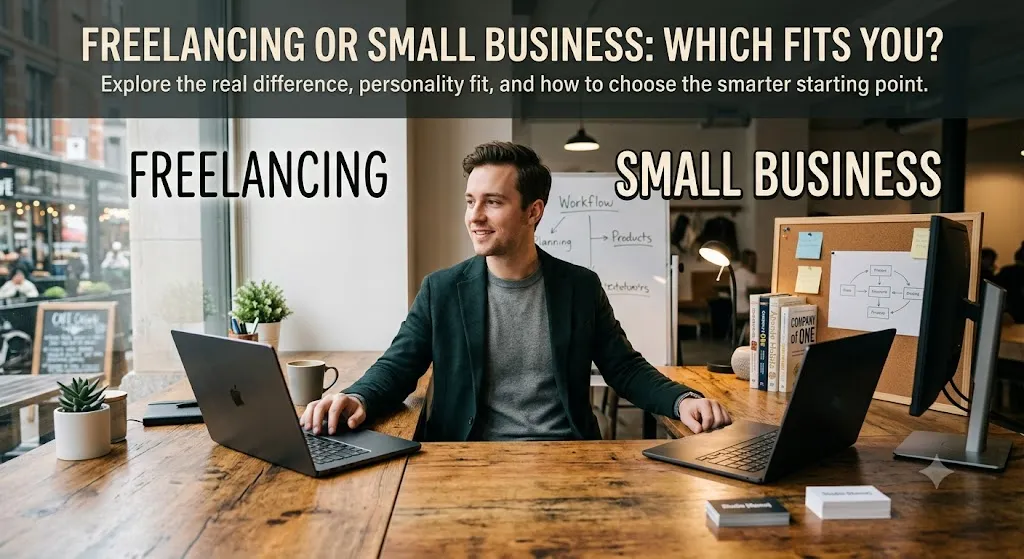
Some people thrive as freelancers because they enjoy autonomy and deep craft. They like doing the actual work, building client relationships, and keeping things lean. They do not want to manage a team or spend their week in meetings about systems.
Others feel boxed in by the freelancer model. They get restless when every growth plan depends on them personally doing more. They enjoy delegating, refining operations, and building a brand that feels bigger than one person.
This is not about ambition versus comfort. It is about fit. Wanting a streamlined solo career is not thinking small. Wanting to expand is not automatically smarter. The best path is the one that matches your strengths, energy, and definition of success.
If you hate admin, conflict, and supervision, a team-based small business may sound better in theory than in reality. If you dislike constant client prospecting and being the face of every project, freelancing may lose its shine quickly.
How to decide between freelancing or small business
Start with the kind of workday you want, not the title you want. Picture a normal Tuesday. Are you happiest doing skilled work yourself, with direct client contact and a flexible schedule? Freelancing may fit naturally. Would you rather spend more time planning, improving systems, and growing something others can help deliver? A small business model may make more sense.
Then look at your current resources. Freelancing often works well if you need to earn soon and already have a saleable skill. A small business is often a better fit if you have patience, some financial cushion, and a stronger interest in building processes.
It also helps to think about your ceiling. If your ideal future still looks like you doing excellent work for a select group of clients, freelancing is not a stepping stone. It may be the destination. If your ideal future involves a team, broader offers, and income that is less tied to your personal hours, build with a small business mindset from the start.
There is one more useful truth here. You do not always have to choose once.
You can start as a freelancer and grow into a small business
This is the route many people take because it lowers risk. You begin by selling your own skills. You learn what clients need, where the demand is, and what pricing the market will accept. Over time, you notice patterns. Certain services repeat. Certain tasks can be documented. Certain client needs could be handled by someone else under your brand.
That is often the moment when freelancing turns into a small business.
The shift can be gradual. You might hire a virtual assistant, bring in a contractor, package your offer, or create a digital product alongside client work. You are still earning, but you are no longer building only around yourself.
For many readers, this blended route is the most practical one. It respects cash flow while keeping the door open to scale.
What people often get wrong
One common mistake is assuming freelancing is casual and business ownership is serious. A well-run freelance career can be disciplined, profitable, and durable. Another mistake is assuming a small business always means freedom. Sometimes it means more responsibility than a regular job, at least for a while.
It is also easy to overvalue status. “Founder” may sound bigger than “freelancer,” but titles do not pay bills or improve your life. What matters is whether your model supports your goals.
That is a good filter for any decision. As Quotela readers know, progress tends to come from clear thinking, not borrowed ambition. The right move is not the one that looks most impressive online. It is the one that gives you momentum you can actually sustain.
If you are standing between freelancing and a small business, give yourself permission to choose based on reality, not noise. Build the path that fits your strengths today and your ambitions for tomorrow. The smartest business model is the one you can keep showing up for when the excitement wears off.
Conclusion: Choose the Work Style That Matches Your Goals
The choice between freelancing and a small business is not about finding the “better” option. It is about finding the model that matches how you want to work, earn, and grow. Freelancing offers speed, flexibility, and direct control over your work, while a small business creates opportunities for systems, scalability, and growth beyond your personal time.
The right decision depends on your skills, personality, financial situation, and long-term vision. If you enjoy being the expert, working closely with clients, and keeping things simple, freelancing may be the ideal path. If you want to build processes, create a brand, and eventually work through a team, a small business mindset may serve you better.
Remember that these paths are not permanent choices. Many successful businesses begin as freelance careers and grow naturally as demand increases. Start with the model that fits your current reality, learn from the experience, and adjust as your goals evolve. The best path is not the one that sounds most impressive — it is the one you can consistently build and sustain.
Key Takeaways
- Freelancing focuses on selling your skills and time, while a small business focuses on building systems and scalable growth.
- Neither path is automatically better; success depends on your goals, strengths, and preferred lifestyle.
- Freelancing can provide faster income and flexibility with lower startup costs.
- Small businesses may take longer to build but can create greater long-term growth opportunities.
- You can start as a freelancer and gradually transition into a small business model.
- Choose based on the type of work and life you want, not just the title that sounds more impressive.
About the Author
Ana Milojevik is a writer and contributor at Quotela.net, a general-interest publication covering business, health, technology, travel, personal development, quotes, and digital trends. She enjoys researching practical topics and creating informative content that helps readers discover new ideas, insights, and useful perspectives.