How Many Ounces Are in a Gallon? A Complete Guide to Volume Conversion
Understanding measurements and conversions is essential for many daily activities, especially when cooking, mixing liquids, or managing supplies. One common question is: how many ounces are in a gallon? This article will cover the answer in detail, explain the different types of ounces and gallons, and provide practical tips for converting between these units.
What Is a Gallon?
A gallon is a unit of volume commonly used in the United States and some other countries to measure liquids. However, the term “gallon” can refer to two primary versions:
- US liquid gallon: Used mainly in the United States for liquid measurement.
- UK (Imperial) gallon: Used in the United Kingdom and some Commonwealth countries.
These two gallons differ in size, so it is important to know which gallon you are referring to.
Understanding Ounces
Ounces can also mean different things depending on the context:
- Fluid ounces (fl oz): This measures volume, primarily liquids.
- Ounces (oz): This measures weight or mass.
For volume conversion, we are focusing on fluid ounces.
How Many Fluid Ounces Are in a Gallon?
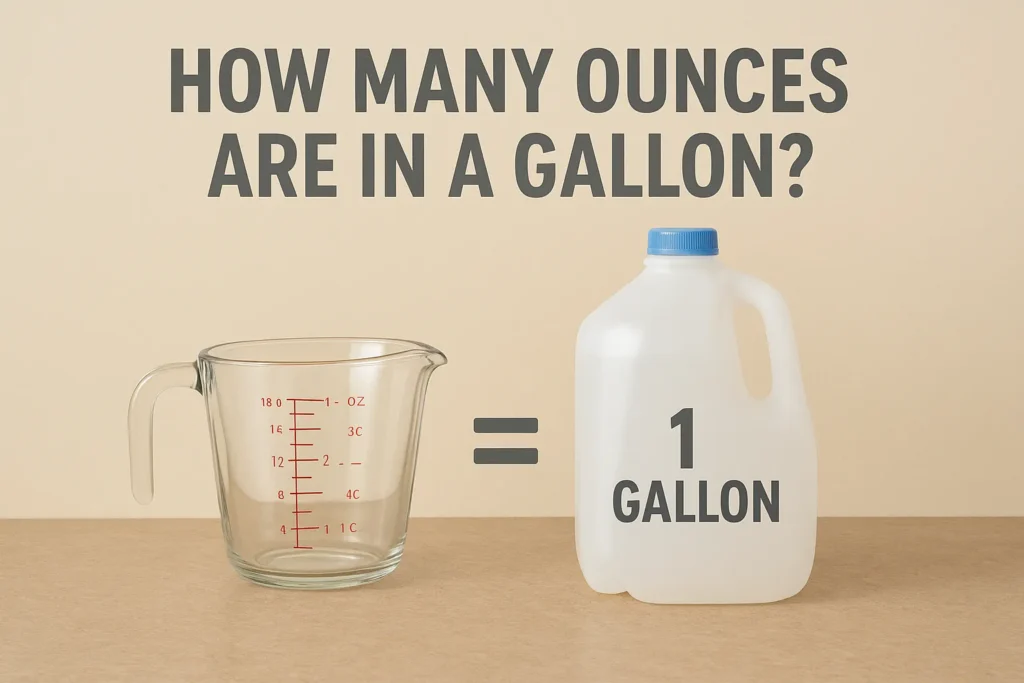
- US liquid gallon: 1 US gallon = 128 US fluid ounces
- UK (Imperial) gallon: 1 Imperial gallon = 160 UK fluid ounces
Why the Difference?
The US gallon is based on the old English wine gallon and equals exactly 3.785 liters. The Imperial gallon is larger, standardized at 4.546 liters. Since fluid ounces are proportional to the size of the gallon, the number of fluid ounces per gallon varies.
Breakdown of Gallon to Fluid Ounce Conversion
| Measurement System | Gallon Size (liters) | Fluid Ounces per Gallon |
|---|---|---|
| US Liquid Gallon | 3.785 L | 128 fl oz |
| Imperial Gallon | 4.546 L | 160 fl oz |
How to Convert Ounces to Gallons and Vice Versa
If you have a volume in ounces and want to convert it to gallons, use this formula (assuming US liquid measures):Gallons=Fluid Ounces128Gallons=128Fluid Ounces
Example:
You have 256 fluid ounces of water.256÷128=2 gallons256÷128=2 gallons
In reverse, to convert from gallons to ounces:Fluid Ounces=Gallons×128Fluid Ounces=Gallons×128
Example:
You want 3 gallons of juice.3×128=384 fluid ounces3×128=384 fluid ounces
Common Uses for Gallons and Fluid Ounces
- Cooking and Recipes: Many recipes use fluid ounces to measure liquids but sometimes call for gallons for large batches.
- Fuel: Gasoline is often sold by the gallon in the US.
- Beverages: Large beverage containers often list fluid ounces and gallons.
- Water Consumption: Daily water intake might be tracked in gallons or ounces depending on preferences.
Tips for Accurate Measurement
- Always check if the recipe or measurement refers to the US or Imperial gallon.
- Use measuring cups or jugs with fluid ounce gradations for precision.
- For greater accuracy, weigh liquids (where 1 US fluid ounce of water is about 1.043 ounces by weight).
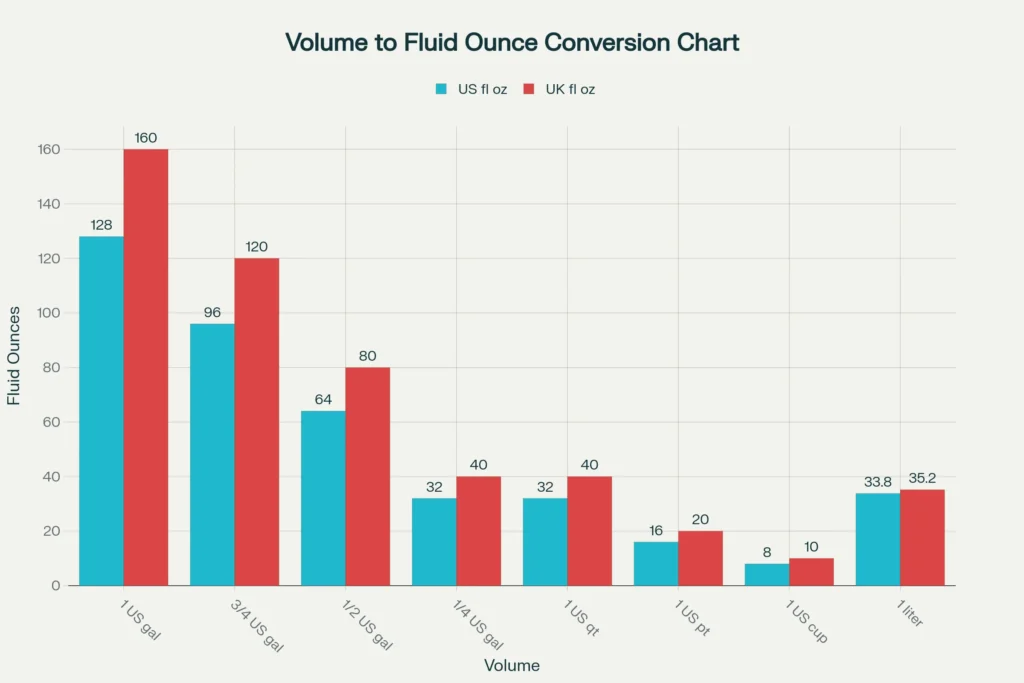
Conversion Chart for Gallons to Fluid Ounces in Both US and UK Systems
| Volume | Fluid Ounces (US) | Fluid Ounces (UK) |
|---|---|---|
| 1 US gallon | 128 | 160 |
| 3/4 US gallon | 96 | 120 |
| 1/2 US gallon | 64 | 80 |
| 1/4 US gallon | 32 | 40 |
| 1 US quart | 32 | 40 |
| 1 US pint | 16 | 20 |
| 1 US cup | 8 | 10 |
| 1 liter | 33.814 | 35.195 |
Quick Reference Conversion Table
| Volume | Equivalent |
|---|---|
| 1 US gallon | 128 US fluid ounces |
| 0.5 US gallon | 64 US fluid ounces |
| 1 Imperial gallon | 160 UK fluid ounces |
| 1 US cup | 8 US fluid ounces |
| 1 liter | 33.814 US fluid ounces |
Historical Background of the Gallon
The gallon has an interesting history that explains why the US and UK use different measurements today. The US liquid gallon is based on the old English wine gallon from the 1700s, while the Imperial gallon was standardized in 1824 to reflect a more consistent measurement system. Understanding this history helps explain why conversions between US and UK gallons aren’t identical and adds depth to the topic.
Why Accurate Volume Conversion Matters
Converting ounces to gallons isn’t just an academic exercise—it has practical implications. Accurate conversions are crucial in cooking, brewing, fuel calculations, and scientific experiments. Even a small miscalculation can lead to spoiled recipes, incorrect chemical mixtures, or fuel measurement errors. Highlighting real-world consequences makes the content more relatable and authoritative.
Metric System Comparison
For global clarity, it’s helpful to compare gallons and ounces to metric units.
- 1 US gallon = 3.785 liters = 128 US fluid ounces
- 1 Imperial gallon = 4.546 liters = 160 UK fluid ounces
Providing metric equivalents caters to international readers and increases the article’s utility.
Practical Conversion Tips
To make conversions faster, you can use simple mental math or tools:
- Double-check your math: Multiply gallons by 128 for US fluid ounces.
- Use apps or calculators: Many free online converters allow quick conversions between US and UK gallons, liters, and ounces.
- Keep a printed chart: Having a small reference chart in your kitchen or workspace reduces errors and speeds up your workflow.
Common Conversion Mistakes
Even seasoned cooks or DIYers can make mistakes when converting ounces to gallons. Common errors include:
- Confusing fluid ounces with weight ounces
- Forgetting the difference between US and Imperial gallons
- Not accounting for temperature changes that slightly affect liquid volume
Including these tips helps readers avoid pitfalls and shows expertise.
Fun Facts About Gallons and Ounces
Adding some trivia can increase reader engagement:
- The average American household uses roughly 15 gallons of water per person per day.
- In some recipes, “a pinch of this, a dash of that” can add up to nearly a fluid ounce if scaled.
These fun facts make the article more shareable and memorable.
Environmental and Practical Considerations
Understanding gallons and ounces can also help with sustainability: measuring exact volumes prevents food or liquid waste. For example, knowing how much oil or water is needed for a recipe avoids overuse and reduces environmental impact.
Frequently Asked Questions
Q: What is the difference between fluid ounces and ounces by weight?
A: Fluid ounces measure volume, primarily of liquids; ounces by weight measure mass. For water, 1 fluid ounce approximately equals 1 ounce by weight, but this varies for other liquids.
Q: Is a gallon used worldwide?
A: No, the gallon is primarily used in the US and UK. Most countries use liters and milliliters in the metric system.
Q: Can I use the same conversion for dry ingredients?
A: No, drying ingredients should be measured by weight (ounces), not volume (fluid ounces).
This guide should help you understand how many ounces are in a gallon, which varies based on measurement systems, and provide a practical base for using these measures effectively.
Related posts:
 TikTok-Famous Food Trends: Viral Recipes and Kitchen Hacks That Took Over 2025
 Making Mistakes Safely: The Smarter Way to Learn Trading with Quotex
 Is the Traditional Classroom Model Still Relevant in the Age of Hybrid Learning?
 Increase Traffic and Conversions Using Expert Website Design and SEO Tactics
 Smart Borrowing: Tips for Choosing an Auto Loan You Can Afford