A Guide to Reading Candlestick Charts
A price chart can look like noise until one candle suddenly tells a clear story: buyers pushed hard, sellers pushed back, and the market left evidence behind. That is why a guide to reading candlestick charts matters. Once you understand what each candle is saying, market moves start to feel less random and far more readable.
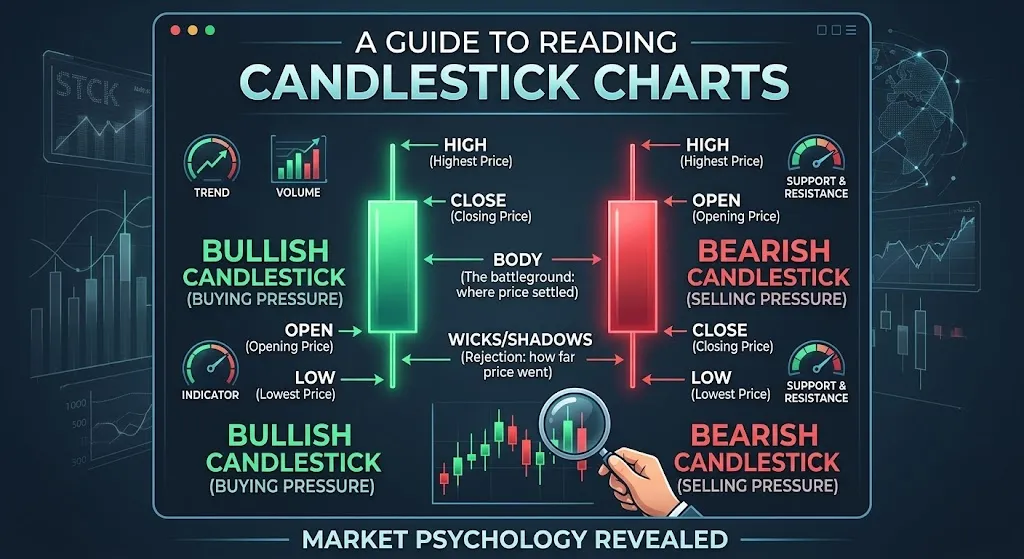
Candlestick charts are popular in stocks, forex, and crypto because they show more than a simple line chart. They reveal the battle between buyers and sellers within a chosen time frame. One candle might represent one minute, one hour, one day, or one week. The structure stays the same. Only the time window changes.
What candlestick charts actually show
Every candlestick has four main price points: open, high, low, and close. The thick part of the candle is called the body, and the thin lines above or below it are often called wicks or shadows.
If the close is higher than the open, the candle is usually shown as bullish. On many platforms it appears green or white. If the close is lower than the open, it is bearish and often shown as red or black. The body shows where price opened and closed, while the wick shows how far price traveled before pulling back.
That alone gives you useful context. A long bullish body suggests strong buying pressure during that period. A small body with long wicks suggests hesitation, conflict, or rejection at certain prices. Candlesticks are not magic signals, but they do offer clues about market psychology.
A beginner’s guide to reading candlestick charts
The fastest way to learn candlesticks is to stop memorizing names for a moment and start reading behavior. Ask three basic questions every time you look at a candle: who was in control, did that control weaken, and where did it happen?
A large green candle after a period of sideways movement may show buyers taking control. A red candle with a long upper wick after a rally may show buyers tried to push higher but could not hold it. A tiny candle in the middle of a strong trend may not mean much on its own. Context decides whether a candle is meaningful or just market breathing.
This is where beginners often get tripped up. They spot one famous pattern and assume a reversal is guaranteed. It rarely works like that. A candle pattern near a major support level carries more weight than the same pattern in the middle of a messy range.
The body tells you conviction
A long body usually means one side had conviction. When a candle closes near its high with a strong body, buyers likely stayed in control into the close. When it closes near its low, sellers likely did the same.
A short body usually means neither side won decisively. That can signal balance, indecision, or simple low volatility. It is not automatically bullish or bearish. It depends on what came before it.
The wick tells you rejection
Long upper wicks show price moved higher but failed to stay there. Long lower wicks show price moved lower but bounced back. Traders often read this as rejection.
Rejection matters most at key areas. If price repeatedly leaves long lower wicks near support, buyers may be defending that level. If price keeps printing long upper wicks near resistance, sellers may be active there.
The close matters more than the drama inside the candle
Many new traders focus too much on the wick and not enough on the close. But the closing price often carries more weight because it shows where the market settled when the period ended.
For example, a candle may drop sharply during the session and still close strong. That tells a very different story than one that drops and stays weak. In many cases, the close is where confidence shows up.
Common candlestick patterns worth knowing
You do not need to memorize dozens of names. A small group of patterns covers most of what beginners need.
A doji has a very small body, meaning the open and close are close together. It often signals indecision. After a strong trend, that indecision can matter. In a choppy market, it may mean very little.
A hammer has a small body near the top of the candle and a long lower wick. It can suggest sellers pushed price down but buyers regained control. It tends to matter more after a decline and near support.
A shooting star is the opposite shape, with a small body near the bottom and a long upper wick. It can suggest failed buying pressure and often gets attention after an upward move.
An engulfing pattern involves two candles. In a bullish engulfing pattern, a strong bullish candle fully covers the prior bearish body. In a bearish engulfing pattern, a strong bearish candle fully covers the prior bullish body. These patterns can hint at momentum shifting, but they work best when they appear at logical turning points.
How to read candlesticks in context
Candlesticks become far more useful when you stop treating them like isolated symbols. A good guide to reading candlestick charts always comes back to context: trend, support and resistance, volume, and timeframe.
Trend changes the meaning
In an uptrend, a single bearish candle may just be a pause. In a downtrend, a single bullish candle may just be a bounce. Patterns against the trend need stronger confirmation.
This is why chasing every reversal candle can be expensive. Sometimes the smarter read is that the trend is still intact and the candle is just noise within a bigger move.
Support and resistance add weight
A hammer at a known support zone is more interesting than a hammer in the middle of nowhere. A bearish engulfing candle near resistance matters more than the same pattern during a random pullback.
Think of support and resistance as places where decisions get tested. Candlesticks show how the test played out.
Timeframe matters more than many beginners expect
A one-minute candle and a daily candle may share the same shape, but they do not carry the same significance. Higher timeframes usually provide stronger signals because they include more market participation.
That does not mean lower timeframes are useless. It means they are noisier. If you are just learning, daily and four-hour charts are often easier to read than one-minute charts that flicker constantly.
Volume can confirm conviction
If your chart includes volume, use it. A strong candle backed by high volume often has more meaning than the same candle on light activity. It suggests broader participation rather than a brief move caused by a thin market.
Volume is not mandatory for reading candlesticks, but it helps separate genuine momentum from weak follow-through.
Mistakes people make with candlestick charts
The biggest mistake is expecting certainty. Candlestick patterns do not predict the future. They show probabilities and behavior. That is a useful edge, but it is not a guarantee.
Another common mistake is relying on pattern names without understanding the story behind them. If you know what buying pressure, selling pressure, rejection, and indecision look like, you can read far more than someone who has memorized twenty pattern labels.
Beginners also tend to ignore risk. Even the cleanest candle setup can fail because markets respond to news, liquidity, and broader sentiment. A good chart read should still leave room for being wrong.
How to practice without getting overwhelmed
The best way to improve is to pick one market and one timeframe and study it consistently. Scroll back through old charts and pause before major moves. Ask what the candles were signaling at support, at resistance, and during trend continuation.
Screenshot examples that make sense to you. Over time, you will start seeing repeated behavior instead of random shapes. That is when candlestick reading becomes practical rather than theoretical.
It also helps to keep your approach simple. You do not need five indicators and dozens of candle names. Start with price structure, key levels, and a handful of patterns that repeatedly show intent.
At Quotela-style speed, the best lesson is this: read candles like a conversation, not a code. Each one shows pressure, hesitation, or rejection. Put that behavior in context, stay humble about what you cannot know, and the chart starts speaking much more clearly.
The goal is not to predict every move. It is to read the market with a little more calm, a little more discipline, and a lot less guesswork.
Ana Milojevik
About the Author
Ana Milojevik is a writer and contributor at Quotela.net, a general-interest publication covering business, health, technology, travel, personal development, quotes, and digital trends. She enjoys researching practical topics and creating informative content that helps readers discover new ideas, insights, and useful perspectives.