Crypto Day Trading for Beginners Explained
Most beginners enter the market thinking speed is the edge. It usually is not. In crypto day trading for beginners, the real edge is staying calm while prices move fast, keeping risk small, and following a plan when emotion starts making noise.
That matters because crypto is one of the easiest markets to access and one of the hardest to trade well. Prices can jump in minutes, news spreads instantly, and social media can push people into bad decisions at the worst possible time. If you are new, the goal is not to score one huge win. The goal is to survive long enough to build skill.
What crypto day trading for beginners actually means
Day trading means opening and closing trades within the same day. You are not buying a coin because you believe it will be worth more in five years. You are trying to capture short-term price moves over minutes or hours.
That sounds simple, but it changes how you think. Long-term investors can ignore a lot of daily noise. Day traders cannot. They need a process for choosing a market, deciding where to enter, defining where to exit, and managing risk before the trade even starts.
For beginners, this is where confusion starts. Many people mix day trading with gambling because both can feel exciting. The difference is structure. Gambling chases adrenaline. Trading should reduce it.
Start with the right expectations
A lot of beginner losses come from unrealistic goals. Social posts often make day trading look like a fast route to freedom. In reality, most new traders lose money because they trade too large, too often, and without a tested method.
A healthier expectation is this: your first phase is education with real market exposure, not income replacement. If you treat your first months like a paid lesson in discipline, you will make better choices. If you expect to double your money quickly, the market will usually punish that mindset.
There is also a trade-off between opportunity and pressure. Crypto moves all day, every day, which creates plenty of setups. It also creates the feeling that you should always be trading. You should not. Sometimes the best move is no move.
Choosing what to trade
Beginners do better when they keep things narrow. Instead of jumping between dozens of trending tokens, focus on a small watchlist. Major pairs with strong liquidity tend to be easier to trade than low-volume coins that can spike and crash with very little warning.
Liquidity matters because it affects how easily you can enter and exit. In thin markets, price can move sharply before your order fills. That can turn a decent setup into a bad trade. For a beginner, cleaner price action is usually better than dramatic price action.
Bitcoin and Ethereum are common starting points for a reason. They are widely watched, heavily traded, and often behave more predictably than smaller coins. That does not make them safe. It just makes them easier to read than the latest token running on hype alone.
The tools you actually need
You do not need a screen full of indicators to start. Too many tools can create false confidence. A basic charting setup, a reliable exchange, and a method for tracking trades are enough in the beginning.
Candlestick charts help you see price movement clearly. Volume shows whether a move has real participation behind it. Support and resistance levels give context for where price may pause, reverse, or break through. That already covers a lot.
You can add indicators later if they genuinely improve your decisions. But beginners often stack tools to avoid making a clear choice. A simple setup that you understand is more useful than a complicated one you cannot explain.
Build one strategy, not five
The fastest way to confuse yourself is to copy a different strategy every week. One trader uses breakouts, another uses moving average crossovers, another trades reversals, and suddenly every chart looks like a mixed signal.
Pick one simple idea and stay with it long enough to learn its strengths and weaknesses. For example, you might trade breakouts above resistance only when volume increases. Or you might wait for pullbacks in an uptrend and enter after price confirms support.
Neither approach works all the time. That is the point. Every strategy has losing trades. The goal is not perfection. The goal is consistency in how you execute.
Risk management is the real beginner skill
If there is one concept that deserves extra attention in crypto day trading for beginners, it is risk management. A great entry cannot save poor position sizing. A bad habit of oversizing can wipe out weeks of effort in one trade.
Decide in advance how much of your account you are willing to risk on a single trade. Many new traders keep that amount very small, often around 1 percent or less. This protects you from the emotional damage of a big loss and gives you room to learn.
Stop-loss orders matter too, but only if you place them logically. A stop should sit at the point where your trade idea no longer makes sense, not at a random distance that simply feels comfortable. If your stop is too tight, normal price movement may knock you out. If it is too wide, your loss may become larger than planned.
This is also why leverage deserves caution. It can amplify gains, but it also magnifies mistakes. For beginners, leverage often creates more stress than benefit. Trading without it, or with very low leverage, usually leads to better habits.
How a basic trading process looks
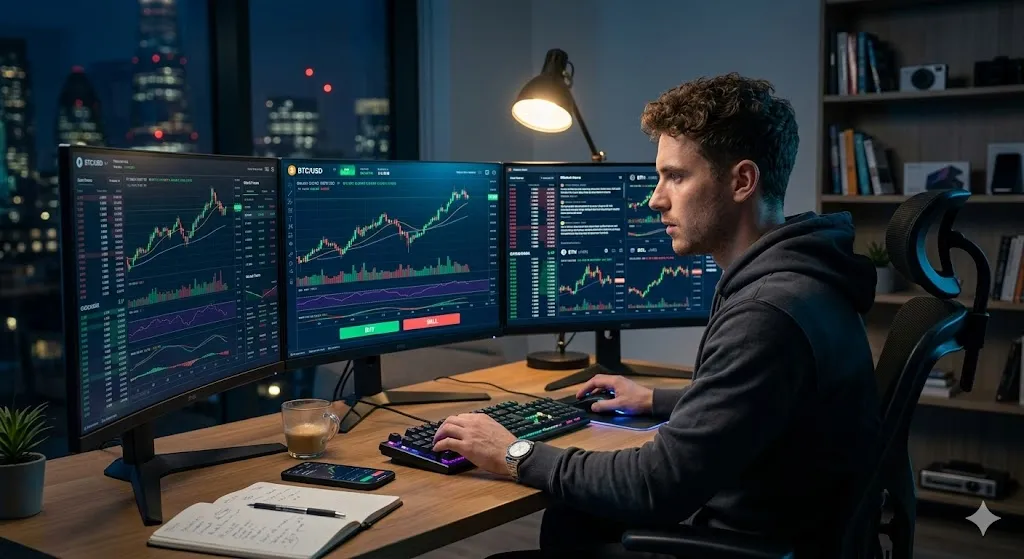
A workable process does not need to be flashy. Before the session starts, identify the markets you want to watch and mark key levels. Then wait. If price reaches an area that fits your setup, you plan the trade before clicking anything.
That means knowing your entry, stop, and target in advance. It means calculating position size based on risk, not excitement. And it means accepting that if the setup is not there, you do nothing.
After the trade ends, record what happened. Note why you entered, whether you followed the plan, and how you felt during the trade. This is where growth happens. A trading journal turns vague memories into useful feedback.
The psychology beginners underestimate
Most beginner mistakes are not technical. They are emotional. Fear makes you exit too early. Greed makes you stay too long. Frustration makes you revenge trade after a loss. Boredom makes you create trades that were never there.
That is why routine matters. If you trade at random times with random rules, your emotions will fill the gap. A repeatable process gives your mind fewer chances to improvise.
It also helps to separate outcome from execution. A winning trade can still be bad if you ignored your plan. A losing trade can still be good if you followed it correctly. That mindset shift is hard, but it is one of the biggest upgrades a beginner can make.
How to Know If Your Day Trading Is Actually Improving
One of the most overlooked challenges in crypto day trading for beginners is knowing whether you are genuinely getting better or simply getting lucky. A few winning trades in a row can feel like progress, but without tracking your results systematically, you have no real way to separate skill from chance. This is why keeping a detailed trading journal is not optional advice — it is the closest thing to a guaranteed improvement tool available to any beginner.
Record every trade with your reasoning, your entry and exit prices, your emotional state during the trade, and whether you followed your plan. Over weeks and months, patterns will emerge that no amount of chart studying can reveal.
You will see which market conditions suit your strategy and which destroy it. You will notice whether you perform better in the morning or the afternoon, after a rest day or during a losing streak. That granular self-knowledge is what separates a trader who is genuinely developing from one who is simply spinning in place, making the same mistakes with increasing frustration.
Why Consistency Matters More Than Your Win Rate
The measure of real improvement is not your win rate — it is your consistency. A beginner who wins forty percent of trades but consistently follows their plan, sizes positions correctly, and cuts losses cleanly is in a far stronger position than someone who wins sixty percent of trades through impulsive decisions and lucky timing.
The disciplined trader has a repeatable process that can be refined and improved over time. The impulsive trader has a habit that will eventually catch up with them in a bad market. As you track your results, look for consistency in your execution rather than obsessing over short-term profit and loss numbers.
Consistency means you entered only when your criteria were met, you honored your stops without moving them, and you did not deviate from your position sizing rules because a trade felt particularly exciting or particularly safe. That kind of consistency, practiced across dozens and eventually hundreds of trades, is what eventually turns a struggling beginner into a trader who can genuinely trust their own process.
Common mistakes that drain new accounts
Beginners often overtrade because crypto never sleeps. They take too many setups, stare at charts too long, and confuse activity with progress. More trades do not automatically mean more learning. Sometimes they just mean more fees and more mistakes.
Another common issue is following influencers into moves that are already extended. By the time a trade looks exciting on social media, the best entry may be gone. Day trading works better when you react to your own rules, not someone else’s momentum post.
Then there is the habit of moving stops. A trader sets a clear exit, price gets close, and suddenly the stop is pushed lower in the hope that the market will turn. Sometimes it does. Over time, this habit becomes expensive.
When day trading may not fit you
It is worth saying plainly: day trading is not the best path for everyone. Some people have the patience and temperament for short-term decisions. Others do much better with swing trading or long-term investing.
If you find that intraday moves make you anxious, distracted, or impulsive, that is useful information. It does not mean you failed. It means your strengths may fit another style better. Smart investing is not about forcing one identity. It is about finding an approach you can actually sustain.
For readers who want clear, useful advice without the noise, that may be the most encouraging truth of all. You do not need to trade constantly to participate in crypto. You just need to be honest about your goals, protect your capital, and improve one decision at a time.
The market will still be there tomorrow. Your job is to make sure your account and your confidence are there too.
Key Takeaways
Day trading is a skill, not a shortcut. Crypto day trading attracts beginners with the promise of fast money, but the reality is that consistent profitability comes from months of disciplined practice, honest self-assessment, and a willingness to treat early losses as tuition rather than failure.
Keep your focus narrow. Beginners perform better when they trade a small watchlist of liquid, widely followed assets like Bitcoin and Ethereum rather than chasing low-volume tokens driven by hype. Cleaner price action is almost always more useful than dramatic price action when you are still learning to read the market.
One strategy, fully understood, beats five strategies half understood. The urge to constantly switch approaches is one of the most common and costly beginner mistakes. Pick a single method, test it consistently, and learn its weaknesses before adding complexity.
Risk management is the most important skill you will ever develop. Position sizing, stop-loss placement, and the discipline to avoid leverage as a beginner matter more than any entry signal or indicator. A well-managed bad trade is survivable. A poorly managed good trade can still destroy an account.
Your emotions are your biggest opponent. Fear, greed, boredom, and frustration cause more beginner losses than poor technical analysis. Building a repeatable routine reduces the number of decisions your emotions can interfere with, which is one of the most practical steps any new trader can take.
Track everything and measure the right things. A trading journal is not a bureaucratic chore — it is the primary tool through which real improvement happens. And when you evaluate your progress, measure consistency of execution first and profit and loss second. A disciplined loser is closer to becoming a winner than an undisciplined one.
Day trading is not for everyone, and that is completely fine. If intraday price movement makes you anxious, impulsive, or unable to think clearly, swing trading or long-term investing may suit your temperament far better. The goal is to find an approach you can sustain honestly, not to force yourself into a style that conflicts with how you naturally think and feel.
About the Author
Ana Milojevik is a writer and contributor at Quotela.net, a general-interest publication covering business, health, technology, travel, personal development, quotes, and digital trends. She enjoys researching practical topics and creating informative content that helps readers discover new ideas, insights, and useful perspectives.